D’Orientations à Documentaire

D’orientations à Documentaire 

Journal Phantom N°2 

Suite d’un échange entamé entre Ismaïl Bahri et Olivier Marboeuf dans le cadre de la résidence de l’artiste au sein de La Fabrique Phantom, et de la présentation de la vidéo Orientations au FIDMarseille 2013.

Marseille, Juillet 2013

Lien vers le texte
1-ismail-bahri-Orientations-2010.jpg
Ismaïl Bahri, Orientations, video, 2010

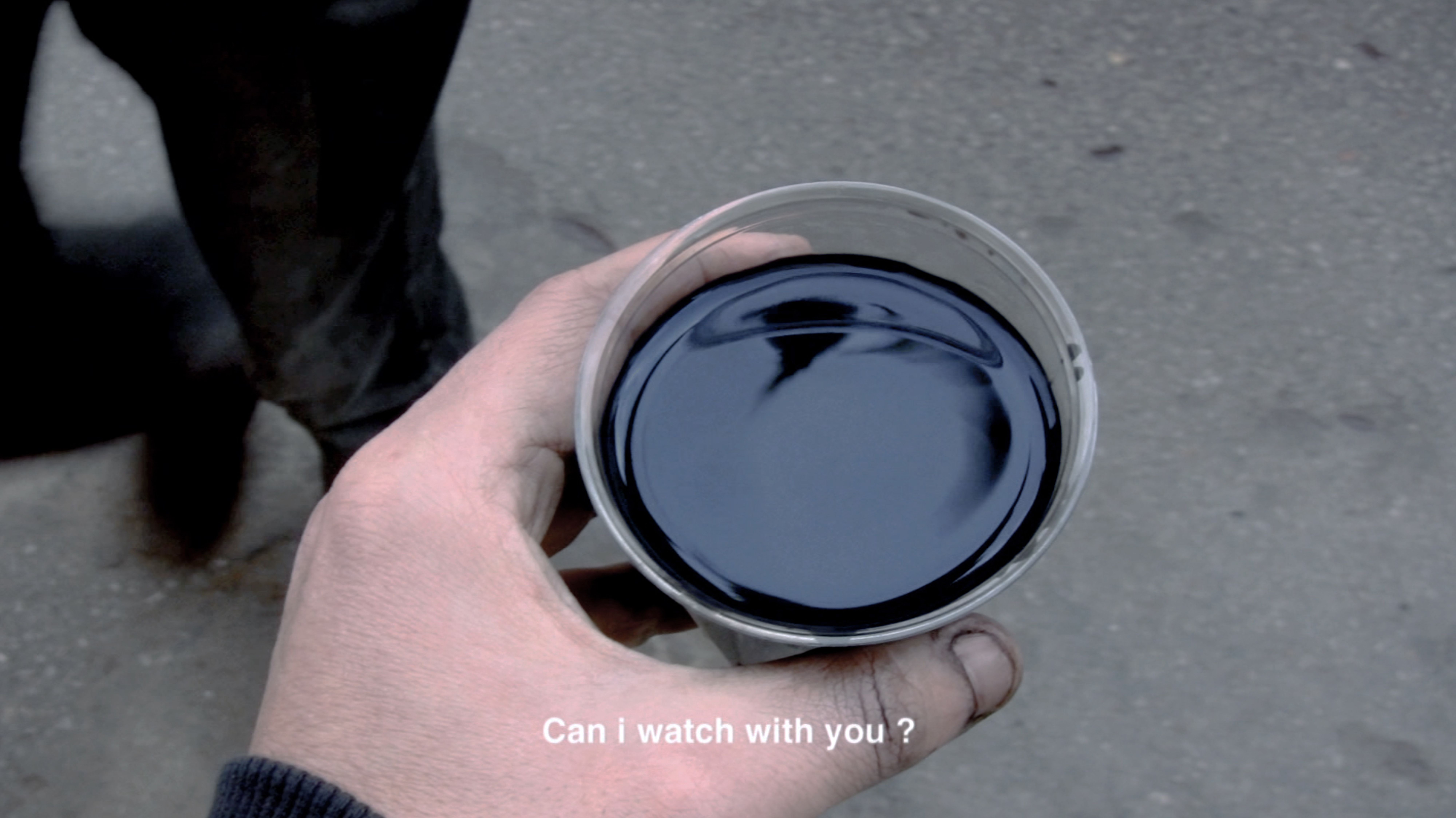
Olivier Marboeuf : Cher Ismaïl, la présentation de ta vidéo Orientations au FID Marseille est une belle occasion de reprendre notre discussion. Orientations pose dès le titre l’idée d’inconnu, de territoire inconnu. Comment se déplacer, trouver sa place (ce qui est aussi une question d’orientation) ? Évidemment, là, cela touche au principe de la saisie. Comme je t’en ai déjà parlé, je m’interroge sur la violence en action dans le geste de nommer, attraper ce qui n’a pas de nom, pour le sortir de l’ombre, pour le fixer. C’est un geste de colonisation qui me préoccupe et comme dans l’histoire de la saisie de la forme de l’île à partir de l’imaginaire de la forme de l’océan, je m’intéresse à la manière dont peuvent se fabriquer des expériences et des récits sans saisie. Aussi, ce que tu mets en place avec Orientations me semble très passionnant, très juste. De nouveau, il s’agit de toucher à distance, de montrer sans nommer, sans saisir de manière définitive. Rien n’est fixé, comme l’indique le tremblement de l’encre dans le verre. Evidemment, dans l’accueil du détail – j’essaie de trouver une expression hospitalière car il y a une vraie douceur dans la manière dont l’image se révèle –, il y a une image double. Celle qui est dans le verre et celle qu’elle suppose, son hors-champ, qui devient soudainement extrêmement présent tout en étant invisible, ce hors-champ que nous finissons par voir mais dans un régime spectral.

Ismaïl Bahri : Marcher, ce verre d’encre à la main, en observant au plus près ce qui apparaît en surface, c’est déjà filmer. Orientations traite du fait de filmer, du geste du filmeur, peut-être. Je me filme en train de tenter de capter des images dans ce verre. Et en ce sens, Orientations fait référence aux origines du cinéma, au moment où les images se faisaient en même temps que se cherchait la recette de leur fabrication, au moment où filmer restait pour une grande part une pure expérience, où l’opérateur n’avait pas totalement pris le pas sur l’expérimentateur. Ce qui m’intéresse encore dans cette vidéo est le fait qu’elle capte une recherche en cours. On y voit un geste d’expérience simple mais légèrement sidérant car encore délicat à nommer. Ce que je veux dire par là c’est qu’au moment où j’ai tourné Orientations, j’avais du mal à saisir ce que j’étais en train de faire, à saisir mon geste pour ainsi dire. C’est peut-être ça qui m’intéresse dans cette expérience : celle de chercher des dispositifs déjouant toute saisie. Déjouant la saisie du geste et déjouant, par là même, la saisie définitive de l’image. Il me semble que c’est le surgissement du hors-champ qui vient, dans le film, mettre des mots sur cette recherche en cours. Le hors-champ est recadré, accueilli dans le verre, mais il s’incarne aussi par le passant qui, à la fin de la vidéo, m’accoste et me questionne sur les raisons de ma présence et sur mon activité. Ce qui m’intéresse dans cet échange est que ce personnage désigne par ses mots le dispositif filmique. Il décrit depuis un autre angle, le sien, ce que le spectateur du film ne peut que fabuler. En cherchant à comprendre ce que j’étais en train de faire, ce personnage devient un intercesseur, un passeur entre les spectateurs et la vidéo en quelque sorte, une sorte d’admoniteur, peut-être dans le sens où l’entendait Alberti. Dans la peinture renaissante, l’admoniteur est ce personnage qui indexe l’élément important d’une scène. Tout en faisant partie de l’espace de la représentation, ce médiateur guide le spectateur dans l’image. Il est passeur se tenant sur le seuil de la peinture, dans l’espace séparant l’oeuvre de son public. Cela rejoint ce qu’on disait sur l’exposition « Mandrake a disparu » et la façon dont certains éléments de l’illusion et du magique participent au dévoilement du tour. Dans Orientations, le dehors arrive par les bords, vers le centre de l’image, pour en désigner le hors-champ d’où il provient. Et il me semble que la manière propre au verre d’accueillir les paysages est proche de celle qu’a le dispositif d’accueillir le personnage. Ces doubles arrivées du hors-champ m’ont permis aussi de lâcher prise, d’admettre une forme de déprise et d’accueillir ce qui arrive, sans chercher à le fixer. Dans ce sens, ce qui m’intéresse dans Orientations est qu’on y voit une façon de filmer par l’entremise d’intercesseurs. Pointer un centre en passant par le détour du hors-champ, que ça soit par l’intermédiaire de ce personnage et par celui d’intercesseurs élémentaires, en l’occurrence ici, la surface de l’encre.

Olivier Marboeuf : Dans le contexte du FID Marseille où le documentaire est à l’honneur, il y a une autre idée qu’il me semble intéressant de mettre au travail concernant Orientations. La scène de l’entrée accidentelle du passant dans le cadre de ton expérience n’est pas seulement une forme de conclusion du film mais un changement radical de son régime. On passe d’une expérience filmée à une expérience documentaire. J’ai l’impression que ce moment nous renseigne sur ce qui constitue justement le seuil de l’expérience documentaire. La captation du réel n’est pas suffisante pour la définir – et la composer – complètement, elle nécessite une certaine réflexivité. Il faut qu’il y ait un autre qui nous permette de nous « réfléchir », de nous penser comme de nous voir. De là, on comprend combien la surface de réflexion – ici, l’encre – est un espace pour voir et pour penser dans le même mouvement.

Ismaïl Bahri : C’est vrai que l’irruption intrusive du passant vient dégonfler une bulle un peu autarcique, enfermée sur elle-même. Quand le dispositif s’est ainsi ouvert – qu’il a éclaté –, je me souviens avoir été très troublé et avoir failli couper la caméra. L’échange qui s’amorce vient redessiner les contours d’une expérience dont on n’a presque aucune information. Il situe géographiquement, informe un peu sur le contexte et introduit pêle-mêle divers éléments car on sent que ce passant cherche à me cerner, à me situer, ou du moins à comprendre ce que je fais et d’où je viens. De là à basculer dans le documentaire, je ne saurais pas trop. Mais je suis d’accord avec toi quand tu situes cela sur une limite. A la fin de la vidéo, nous ne sommes plus dans l’expérimentation et pas encore dans le documentaire. On a peut-être ici les éléments d’un documentaire en germe, un documentaire latent.

From Orientations to documentary

From Orientations to documentary

Phantom Journal N°2 

Continuation of an exchange between Ismaïl Bahri and Olivier Marboeuf, begun as part of the artist’s residency with La Fabrique Phantom, and in relation to the presentation of the video Orientations at the FID Marseille 2013.

Marseille, July 2013

Link to the text

1-ismail-bahri-Orientations-2010.jpg
Ismaïl Bahri, Orientations, video, 2010

Olivier Marboeuf: Dear Ismaïl, the presentation of your video Orientations at the FID Marseille is a good occasion for us to continue our discussion. Already by its title Orientations evokes the idea of the unknown, of unknown territories. How do we move, how do we find our place (which is also a question of orientation)? Obviously this touches on the principle of seizure/repossession. As I’ve already mentioned to you, I think about the innate violence in the act of naming, of catching hold of what is nameless, bringing it out of the shadows and fixing it in place. It is an act of colonization that preoccupies me and as in the case of the repossession of the form of the island from the idea of the form of the ocean, I’m interested by the way in which experiences and narratives can be fabricated without repossession. And so what you set in place with Orientations seems very exciting to me, very accurate. Again, there is a question of touching from a distance, showing without naming, without repossessing in a definitive way. Nothing is set in stone, as the trembling ink in the glass bears witness. Clearly in the attention to detail—I’m trying to find a welcoming expression because there is a real softness to the way in which the image is revealed—there is a double image. The one in the glass and the one the former presupposes, the ‘out of range’ that suddenly becomes extremely presently even as it remains invisible, this ‘out of range’ that we finally do see, but only in a spectral register.

Ismaïl Bahri: Walking, glass of ink in hand, minutely observing what appears on its surface, is already filming. Orientations considers the act of filming, the gestures of the person filming, perhaps. I film myself trying to capture the images in that glass. In this sense, Orientations makes reference to the origins of film, to the historical moment when images were filmed at the same time as the recipe for their fabrication was made, at a time when filming remained for the most part a simple experimentation, where the operator was not necessarily ahead of the experimenter. What continues to interest me with this video is the fact that it captures a research in progress. We see a simple experiment that is also slightly astonishing, because difficult to name. What I mean by that is that at the time I was making Orientations, I had difficulty establishing what I was doing exactly, I had difficulty taking hold of my gestures, to put it another way. It was maybe this that interested me so much with this experience: discovering ways of functioning without ever determining a specific modus operandi. Not determining the gesture and thus avoiding the definitive capture of the image. It seems to me that it is the emergence of the ‘out of range’ that, in the film, finds words to describe the research in progress. The out of range is re-framed, received in the glass, but it is also revealed by the passer-by who, at the end of the video, approaches me and asks about the reasons for my presence and my activity. What interests me in this exchange is that this person designates the filming process in his own words. He describes it from a different angle, his angle, a view someone watching the film can only imagine. While trying to understand what I was doing, this character became an intercessor, a go-between, if you will, between the spectator and the video, a sort of admonitor, perhaps in the sense that Alberti intended. In Renaissance painting, the admonitor is the figure who indexes the important elements in a scene. Integrated into the representational space, this mediator guides the spectator through the image. He is the go-between, waiting at the threshold of the painting, in the space that separates the work from the public.

This relates to what we were saying about Mandrake has disappeared and the way in which certain elements of illusion and magic were part of the unveiling of the trick. In Orientations, the outside arrives, via the edges, and comes into the center of the image, thereby designating the hors-champs or out of range from which it came. And it seems to me that the way the glass receives the surrounding landscapes is similar to the device receiving the character. These doubles arriving from the ‘out of range’ allowed me to let go, to accept what happens, without trying to control it. In this sense, what interests me in Orientations is that we see a way of filming via the intervention of intercessors. To indicate a center by way of the ‘out of range’, whether through the intermediary of this figure or elementary intercessors, in the case, the surface of the glass of ink.

Olivier Marboeuf: In the context of the FID Marseilles, where the documentary is spotlighted, there is another idea that seems interesting to consider in connection with Orientations. The scene of the accidental entry of the passer-by into your experiment is not only a form of conclusion to the film, but also a radical change in its register. We go from a filmed experience to a documentary experience. I have the impression that this moment shows us a great deal about what constitutes the threshold of the documentary experience. The capture of the real is not enough to define it—and compose it—completely, a certain reflexivity is needed. There has to be an ‘other’ who allows us to ‘reflect’, to both think us, as well as to see us. From there, we understand how much the reflecting surface—the ink in this case—is a space for both seeing and thinking in the same movement.

Ismaïl Bahri: It’s true that the intrusive eruption of the passer-by explodes a rather autarcic bubble, totally turned into itself. When the device opened out—when the bubble burst—I remember being very troubled. I almost stopped filming. The unexpected exchange redefines the contours of an experience for which we have almost no information. It situates the experience, gives information about the context and introduces different elements, all at once, since we get the feeling the passer-by is trying to target me, to situate me, or at least to understand what I’m doing and where I’m coming from. From there to shifting into the documentary genre…I’m not sure. But I agree with you when you say that this moment defines a limit, a turning point. At the end of the video, we’re no longer in the domain of experimentation and not yet in a documentary. We may have here the elements of a documentary in gestation, a latent documentary.