Estetik ile Politika Arasında

Orta Format | Merve Ünsal

Orta Format tarafından, terminoloji etrafında şekillenen bu yazı dizisinin bir parçası olarak “estetik politika” terimiyle hesaplaşmaya davet edildiğimde, zihnim terimin Türkçeden İngilizceye çevirisinde ortaya çıkabilecek çeşitli sözcük birleşimlerini arasında gidip gelmeye başladı. Çeviri sırasında terim şekil değiştirebilirdi. “Politikanın estetiği” (aesthetics of politics), “estetiğin politiği” (politics of aesthetics), “politik olarak estetik” (aesthetics as politics) ve “estetik olarak politik” (politics as aesthetics), “estetik politika”nın olası çevirileri arasında yer alıyor.

Lydia H. Liu’nun çeviriyi “epistemolojik [1] [2] geçiş”e[1] dair bir mecaz olarak tanımlaması, çeviriyi bir hareket biçimi ve bir bilgi üretim aracı olarak konumlandırmaya yardımcı olur. Çeviri yalnızca anlam aktarmaz; düşünce sistemleri arasında hareket ederek bilgi üretir. “Estetik politika”nın bu dört çevirisi, bana estetik ile politikanın sabit kategoriler olarak kalmak yerine birbirlerinin içinden nasıl geçtiklerini izleme olanağı sunuyor. Aynı şekilde, bir yazma biçimi olarak çeviri girişimi, Walter Benjamin’in çeviriyi dilin kendi ötesini tanıma ve mümkün kılma pratiği olarak kavrayışına dayanır. Benjamin dili, hakikatin hem mekânı hem de arayışı, bir geçidi, bir pasajı olarak tanımlar. Estetik politikanın pasajı, içinde yaşadığımız bugünün dünyası hakkında neyi açığa çıkarabilir? Ve daha acili, estetik politika bu dünyayı değiştirmemize nasıl yardımcı olabilir? Estetik politika’yı çevirmenin devrim[3] [4] sel potansiyeli nedir? Bu metinde, estetik ile siyaset arasındaki hareket alanında yaşayan ve bunu yaşadığımız çağdaş zamanla özgül bir ilişki içinde yapan hareketli görüntülere odaklanıyorum.

Estetiğin Politikası

Desire Machine Collective, Daily Check Up (2005) adlı işinde, “dayatılmış coğrafyalar bölgesinde deneyimlenen ve bir ulusun tahayyülünün çeperine itilmiş” gündelik şiddete bakar.[1] Video, artık aşina olduğumuz güvenlik kamerası görüntülerini andırır, ancak bu görüntüler sanatçılar tarafından üretilmiştir. Ekranda gördüğümüz her şey aslında bir yeniden canlandırmadır.

Daily Check-up’ta Desire Machine Collective, temsil mekânlarını yeniden üretir; tekrar, yeniden canlandırma ve yeniden formülasyon aracılığıyla gözetim alanını bozguna uğratır. Split-screen video[1] [2] [3] , iki ayrı kamera görüntüsünü bir araya getirir. Her iki görüntü de parlak, beyaz bir ışıkla açılır. Genç erkeklerin yer aldığı performansta kamera, bir denetimi çağrıştıracak şekilde ışıkla hizalanmıştır.[2] Genç erkekleri çeken kameranın konumlanışı ile denetim rolündeki ışığın yerleşimi; kamera ile ışık, kayıt eden unsur ile ifşa eden unsur arasında ince bir ilişki kurar. Aparna Sharma, protestonun yeniden canlandırıldığı bu görüntülerde kameranın güvenlik güçleriyle işbirliği yaptığını vurgular, zira çoğu zaman kamera operatörlerinin çekim yapabilmek için gerekli izinleri almış olması gerekir. Bu işbirliği tarafsız değildir, çekim eylemini denetim sistemlerinin içine dâhil eder. Bu nedenle denetleyen ve gözetleyen güvenlik güçleri ile gösteren kamera, belirli ölçüde birbirine bağlıdır. Dahası, sanatçılar sahnelemede kamerayı genç erkeklerin bedenlerine yakın konumlandırır;[3] böylece bakışı, bu bakışın öznesi olan bedenlere doğru yeniden yönlendirirler. Sanatçılar, alan derinliğini nötralize eden ve kameranın her hareketini büyüten telefoto lensler kullanır.

[4] Bu tercih, protestolara ilişkin haber görüntülerindeki pan çekimlerle —hareket eden bir öznenin pozlama süresince takip edilmesi sonucu merkezdeki figür dışında her şeyin bulanıklaştığı etkiyle— bedenlerin hareketini yakalayan estetikle açık bir karşıtlık içindedir.[5] 

Sabit kamera hareketlerine, bir durumu kurmak adına diğerlerini görmezden gelen perspektiflere ve ekrandaki olay örgüsünü oluşturan hızlı kurgulara alışkın izleyiciler için Daily Check-up izlenmesi zor, hayal kırıklığı yaratan bir iştir; çünkü ne olduğunu anlamak ve takip etmek güçtür.[1] Sanatçılar denetleyici ışığı kamerayla hizalayarak, görüntü üretimi ile devlet aygıtları arasındaki örtük izin ve temas ilişkilerini görünür kılar. Yeniden canlandırma, protestocuların bedenlerini görüntülerden bilfiil silen sürecin koşullarını yeniden üretir; böylece protestocuların görüntülerine, gözetleyen güvenlik kamerası bakışını benimsemeden bakmanın imkânsızlığına işaret eder. Telefoto lens kullanımı, bu canlandırmayla araya ikinci bir mesafe daha koyar; izleyiciyi, gözetleyenlerin denetimine ve muamelesine maruz kalan gerçek bedenlerle daha doğrudan yüzleşmeye zorlar.

Desire Machine Collective, farklı bir aygıt tarafından kaydedilen yeni bir bakış için yeni bedenler inşa eder; böylece özgün protestocu bedenleri dolaşımdan çekerek onlarla ilişkisini keser. Ancak bu bir silme işlemi değildir; çünkü bu canlandırma, kurgusunu bir düzeltme, bir yeniden hizalama ve yeniden sahneleme olarak konumlandırır.[1]  Bu canlandırma, hareketlerin abartıldığı ve kameraların titrediği yeni bir zamanda yeni bir mekân üretir.

Daily Check-up’ı, estetiğin politikasının bir uzantısı olarak okuyorum. Desire Machine Collective, gözetimin altyapılarını yeniden canlandırarak gözetim estetiğini söküme uğratır. Gözetim gündelik hayatın içine sızmıştır ve Daily Check-up, gözetimin tabiiyet nesneleri üretmek için kullandığı mekanizmalara müdahale ederek estetiğin politikasını açığa çıkarır. Görülen ve deneyimlenen şey, o görüntülerin nasıl üretildiğinin politikasından ayrı düşünülemez. Bu nedenle Daily Check-up, “estetiğin politikası” ifadesindeki “-in” ilişkisinde konumlanır; estetiğin daha kuruluş anında zaten politik olduğunu gösterir.

Politikanın Estetiği

Ismaïl Bahri, Foyer (2016) adlı işinde, kamerayı farklı bir mekân üretmek için kullanarak, görüntü yapım sürecini yeniden kurar. 31 dakikalık film, basit ama radikal bir jestle başlar: kameranın göstermesi beklenen şeye müdahale etmek. Bahri, kameranın objektifinin önüne beyaz bir kâğıt yerleştirerek görüntü üretimine fiziksel olarak müdahale eder. Araçlar ve açılar aynıdır, ancak artık bir engel vardır. Film boyunca, filmin açık havada çekiliyor olmasından ötürü, kâğıt hafifçe hareket eder; böylece değişen gün ışığını ve rüzgârı kaydederek açığa çıkarır. Film ilerledikçe, film ekibi ile yoldan geçenler arasında Arapça gerçekleşen konuşmalar, ekranın tam ortasında, İngilizce altyazılar olarak belirir. Ses ve dil, görüntünün kendisinden daha büyük bir ağırlık taşımaya başlar.

Bahri, filmin önermesini daha ilk anlarda kurar. İzleyiciler kulak misafiri olma deneyimine alışırken, film hızla birbirini izleyen konuşmalar arasında geçiş yapar. Figürlerin ve bağlamın yokluğu, bu dinleme hissini güçlendirir; bu da izleyicinin her şeyi bilen bir gözlemci konumuna ne kadar alışık olduğunu açığa çıkarır. Ne kadar çok şeyi görebildiğimizi kanıksamış durumdayız; buna karşılık Bahri’nin filmi, bize alışık olduğumuzdan çok daha azını göstererek bu görme arzusunu öne çıkarır. Bahri’nin izleyiciyi bu şekilde konumlandırması, filmin bir anında görüntünün tamamen kararması ama konuşmaların duyulmaya devam etmesiyle daha da karmaşıklaşır. Çok geçmeden film yapımcısının, neden çekim yaptığını sorgulayan polis memurlarıyla konuştuğunu anlarız. Bahri onlarla konuşurken objektif kapağı kameraya takılmıştır. Filmin üretimine yönelik bu ikinci fiziksel müdahale — polislerin talebiyle Bahri tarafından gerçekleştirilen müdahale — kamusal alanda kamera kullanan bir filmcinin, o kameranın mevcudiyeti hakkında yine o kamusal alanın sakinleriyle konuşmasının koşullarını ifşa eder; bu durum da mekândaki gözetim mekanizmalarıyla çelişir ve onları açığa çıkarır. Film artık gözetimi belgelemenin ötesinde, gözetimle birbirine dolanır. Bu an, rüzgârın kâğıdı neredeyse tamamen kaldırdığı ve Bahri’nin ağaçlar, banklar ve birkaç insanın bulunduğu kamusal bir meydanda olduğunu kısa süreliğine gördüğümüz başka bir anla karşıtlık oluşturur. Bahri, hiçbir şeyi filme alamama hâlinin absürtlüğüne işaret ederek gözetim mekanizmasını ortadan kaldırır. Böylece filmi dolduran konuşmalar, görüntüsüz protagonistlere dönüşür ve izleyicinin dikkatini, kamusal alanı kimlerin doldurduğuna ve bu protagonistlerin aslında ne hakkında kaygı duyduklarına çeker. Üstelik bunu, görüş alanı bir kâğıtla kapatılmış bir kameranın hilesi aracılığıyla yapar.

Bahri’nin filmi, görsel olarak neredeyse hiçbir şey göstermeyerek kendisini gözetim alanından açık biçimde ayıran bir alan yaratır. Hareketli görüntünün sınırlarını izlerken, izleyiciyi o görüntüden mahrum bırakır. Film, göremediğimizde ne olduğuna, görmediğimizde nasıl konuştuğumuza ya da aslında görmeye ne denli alışmış olduğumuza dair bir egzersizdir.

Filmden tanınabilir görüntüleri ve anlatıları geri çekerek, dünya çapında giderek daha fazla sınırlandırılan kamusal alanlarda olup bitenlerin absürtlüğüne ve bu alanların içkin şiddetine işaret eder Bahri. İzleyiciler olarak görüntüdeki en küçük harekete tutunuruz; anlatı düzleminde gerçekleşen konuşmalar ise hiperodak hâline gelir. 

Bahri’nin kamusal alandaki fiziksel mevcudiyeti bir düzeneğe dönüşür — film artık kameranın gördüğü şey hakkında değil, kameranın mevcudiyeti hakkındadır. Böylece kameranın kendisi filmin öznesine dönüşür.

Politika Olarak Estetik

Trinh Minh-ha’nın Reassemblage: From the Firelight to the Screen (1982)[1] isimli, Senegal’de çektiği görüntüler ile kendi sesinden aktarılan bir voice-over’ı bir araya getiren kırk dakikalık filmi; bir kültürel çevirmen, filmi yapan ve anlatan kişi olarak Minh-ha ile Senegalli özneleri arasındaki ilişkiyi söküme uğrattığı sayısız strateji içerir. Parçalı seslendirmesinde Minh-ha, Senegal hakkında konuşmadığını, bunun yerine Senagal’in yakınından konuştuğunu tekrar tekrar dile getirir. Tekrar edilen bu ifade üç işleve hizmet eder: İlki, konuşmanın öznesi ile hakkında konuşulan özne arasındaki mesafenin, “yakınından” zarfı aracılığıyla kabul edilmesi ve ifadeye dâhil edilmesidir. “Yakınında” sözcüğünün kullanımı, konuşan ile konusu arasındaki tüm mesafelere ve bu mesafelerin konuşma tarafından aşılıp aşılmadığına işaret eder. Bu ifade, zorunlu olarak karşıtını da içerir ve bu nedenle konuşan ile özne arasındaki boşluğa yerleşir. İkinci olarak, “hakkında konuşmak” ile “yakınından konuşmak” arasındaki ayrım, bir yer ya da bir halk hakkında konuşurken varsayılan otoriteleri sarsar. Minh-ha bu ayrımı yaparak kendi sözünü başka sözlerden ayırır; yalnızca konuşma itkisini değil, bunu reddetmenin de mümkün olduğunu kabul eder. Bu durumda sessizlik ya da reddetme etik bir pozisyona dönüşür. Üçüncü ve belki de biçimsel ve kavramsal olarak en önemli işlev ise, Minh-ha’nın bu ifadeyi birçok kez tekrar ederek voice-over metninin kendisini altüst etmesidir. Tekrar yoluyla ifade büyüsel bir niteliğe bürünür: konuşan ile özne arasındaki sınırı gevşetmeye yönelik, kendini yatıştırıcı bir girişim hâline gelir. Konuşan ile özne, açıklayıcı bir ilişki kurmadan aynı alanı işgal eder. İzleyici de bu geçirgen anlatı alanına dâhil edilir; bize hitap edilmez ya da bizimle konuşulmaz . Biz yalnızca oradayızdır. Sanatçı konuşur ve anlatıyı kurarken de konuşmayı sürdürür; bu da sözünün devam eden bir eylem olduğu hissini güçlendirir. Buradaki zaman doğrusal değil, katmanlıdır. Geçmiş şimdi içinde var olurken gelecekte de çoklu biçimlerde varlığını sürdürecektir, birbirine temas eden ve eşzamanlı bir zamansallık.

Minh-ha ayrıca “her yerde mevcut olma” hâlinden söz eder; bu ifade “göz” (eye) ve “ben”e (I) işaret ediyor olabilir. (İngilizce)[2] konuşma dilindeki “eye” ve “I” arasındaki muğlaklık, Minh-ha’nın montajının izleyici/dinleyiciye tam da burada deneyimlettirdiği şeydir: “Ben” adına konuştuğu ve onu temsil ettiği varsayılan göz, muğlak bırakılır; böylece izleyici bu ikisini birbirinden ayırabilir: Bir ben'in var olduğu yerde, ben'ler için konuşur gibi gözüken gözü üretmek üzere bir göz ortaya çıkar[5] [6] .

Minh-ha’nın Senegal etrafında kurduğu görüntü montajı, mekânla kurduğu kırılgan ilişkiyi kabul eder; bu ilişki, görüntülerin tekrarlı ve parçalı kurgusuyla daha da güçlenir. Film, belgesel sinemacının sabit, her şeyi gören, otoriter göz konumunu yerinden eden çok sayıda bakış açısı kullanır. Minh-ha’nın görüntüleri, sanki meraklı bir gözle toplanmış ve ilginç bulduğu unsurlara geri dönülmüş gibi dolaşır. Filmi yapma amacındaki muğlaklık ya da belirsizlik, bakma ediminin kendisini öne çıkarır; Minh-ha kendisini neredeyse kusur noktasına kadar didikler ve her montajın kaçınılmaz olarak içinde bir yeniden montajı barındırdığı, dolayısıyla çözülmeye mahkûm olduğu fikrine yaslanır.

Minh-ha’nın yöntem olarak yeniden montajı, bir film yapımcısı olarak pratiğe döktüğü politikanın mantığını içselleştirir. Film, sesin yavaşça görüntünün içine sızdığı bir siyah ekranla başlar; sanki seyirciye Minh-ha’nın görüntüsünü inşa ettiğini hatırlatır: Şeyler yalnızca görülmez ya da gözlemlenmez; inşa edilir, dile getirilir. Reassemblage’da film yapımının, antropolojik gözlemin ve kaydın politikası, ilişkilerin kurulduğu ve ayarlandığı bir duyarlılığa, estetiğe dönüşür.

Estetik Olarak Politika

Patty Chang’in iki kanallı video yerleştirmesi The Product Love (Die Ware Liebe)[1] (2009), süreğen bir çeviri alanıdır. Sanatçı işi birçok pasajın içinde konumlandırır: diller (Almanca, Çince ve İngilizce), modaliteler (pornografi, bir dilden diğerine canlı çeviri, konuşma), dönüşüm (makyaj ve kostüm aracılığıyla bir kişiden başka birinin kurmaca versiyonuna geçiş). İşin iki kanallı sunumu bu yapıya bir katman daha ekler. Kanallardan biri, Walter Benjamin’in 1928 tarihli A Chinoiserie Out of the Old West başlıklı metnini çevirmeye çalışan üç akademisyeni gösterir. Benjamin bu metinde Çinli-Amerikalı oyuncu Anna May Wong ile karşılaşmasını anlatır. Metnin şiirsel düzyazısını çevirmek güçtür; akademisyenler sözcükler ve s[1] öz dizimleri üzerinde tökezler, Benjamin’in ifadelerini uzun açıklamalarla açar ve ilerledikçe bir ifadenin hedef dilde başka nasıl kurulabileceğini tartışırlar. Yüksek sesle okuyup çevirilerini anlık olarak formüle ederken gerçekleşen canlı çeviri eylemi, çevirinin zorunlu olarak kusurlu doğasını daha da görünür kılar. Benjamin’in sözlerini anlama süreci, aynı anda başka bir dile geçişle gerçekleşir; cümleler, sentakslar, sözler[2]  ve duygulanımlar boyunca hareket eder. Ekranda performe edilen bu görece huzursuz eylem, çeviri alanını açar: çevirmenler çevirdikleri işin anlamını bütünüyle aktarmakta zorlanması, eserin sözcüklerden fazlasını içerdiğini açığa çıkarır.

Çevirinin kayganlığı, işin ikinci kanalında daha da belirginleşir; bu bölüm bir yanlış çeviri üzerine kuruludur. Wong ile Benjamin arasında geçen orijinal sohbette Benjamin, Wong’a artık film yapamasaydı ne yapacağını sorar. Wong “touch wood” (“Aman tahtaya vur”) der, fakat bu ifade kayda “touch would” (“Dokunsan olurdu”) olarak geçer. Wong’un nazar savuşturma niyeti, çeviride boşa düşer.[3]  Chang, bu yanlış aktarımı temel alarak, Benjamin ve Wong’u canlandırmaları için açıkça ve absürt bir biçimde hazırlanmış iki oyuncuyu kamera önünde pervasızca yakınlaştırır. Bu kurgulanmış “dokunsallık”, bir yanlışlığın karikatürü değil, bir çeviridir. [4] [5] Chang’in işi, diller arasında kesişen ve zamansallıklar, tarihler, diller, insanlar ve mekânlar arasında var olan bir öznelerarasılıkla hesaplaşan bir çevirinin cisimleşmesi olarak işler. Wong ve Benjamin’in yerine geçen figürler, özgün Wong ve Benjamin’e dokunur. Aynı Benjamin’in özgün metninin kamera önündeki çevirilere dokunması gibi, kamera önündeki sahte dokunsallık da kamera dışındaki gerçek yakınlığa dokunur. Chang’in The Product Love (Die Ware Liebe) adlı işi bir çeviridir ve çeviriler tarafından kurulur: Chang, çevirinin nesneler ile özneler arasında işleyen, etkileri ve duygulanımları bakımından zorunlu olarak istikrarsız bir yöntem olduğuna işaret eder.

Chang’in işi dil, insan ve ekran ikililiklerinin etrafında kuruludur. Şeyler arasındaki bu kayganlık, huzursuzluk ve işin kavramsal ve biçimsel olarak üzerinde durduğu istikrarsız zemin, estetiğin içine gömülü bir politika biçimine işaret eder. Estetiğin içinde ikamet etmeyen, ama onun tarafından içerilen bir politika. Olasılık anlarını somutlaştırmak için estetiği yarabilen bir politika. Hem estetik tarafından talep edilen hem de onun tarafından harekete geçirilen bir politika.

“Estetik politika”yı “politikanın estetiği”, “estetiğin politikası”, “politika olarak estetik” ve “estetik olarak politika” olarak çevirmeye çalışma çabası, içinde bulunduğumuz; kesişen, açılmaya devam eden ve süreğen çöküş ve kriz anında, estetik ve politika gibi yüklü terimleri sorgulamanın —ve bundan kaçınmamanın— hayati olduğuna dair derin inancımdan kaynaklanıyor. Kendimizi ve pratiklerimizi bu terimlerle ve onların farklı tezahürleriyle ilişki içinde konumlandırarak, onları hem birbirimizle hem de dünya ile ilişki kurmamıza yardımcı olabilecek, özünde dinamik ama gerekli iletişim araçları olarak kavramaya başlayabiliriz. Sanat üretimi son derece kişisel ama nihayetinde kamusal bir uğraştır; başka dünyaların, başka ilişkilerin, başka dolaşıklıkların mümkün olduğunu görünür, işitilir ve duyumsanabilir kılar. Daha önce geride bırakılanı erişilebilir hâle getirme potansiyeli, politik olan tarafından özgürleştirilen estetik bir uğraştır. “Estetik politika”, sayısız çevirisi içinde, biçimler, ilişkiler ve dünyalar arasında onları sabitlemeden hareket etme pratiğine isim verir.

Kaynakça ve Notlar

[1] Lydia H. Liu, Translingual Practice: Literature, National Culture, and Translated Modernity—China 1900-1937 (Stanford: Stanford University Press, 1995), 1. 
2 Umachandran, Shalini. 2018. “Art Cries off the Wall.” LiveMint, May 4, 2018. https://www.livemint.com/Leisure/TyPpfseWKWQ004fu6fdnhO/Art-Cries-off-the-wall.html.
3 Aparna Sharma. “An Arrested Eye: Trauma and Becoming in Desire Machine Collective’s Documentary Installations” in Documentary Films in India. (London: Palgrave Macmillan, 2015), 125.
4 A.g.e., 125
5 A.g.e., 128
6 A.g.e., 127
7 A.g.e., 128
8 https://mubi.com/es/notebook/posts/ismail-bahri-introduces-his-film-foyer
9 Trinh T. Minh-ha, Reassemblage: From the Firelight to the Screen (Wychoff, New Jersey: Women Make Movies, 1982). 
10 Çevirmen eklemesi
11 https://jeudepaume.org/en/evenement/reassemblage-trinh-t-minh-ha/
12 Patty Chang, The Product Love (Die Ware Liebe), 2009. Two-channel digital video installation, 42 min. Solomon R. Guggenheim Museum, New York, https://www.guggenheim.org/artwork/26179.
13 https://www.guggenheim.org/artwork/26179

Between Aesthetics and Politics

Orta Format | Merve Ünsal

When I was invited by Orta Format to reckon with the term “estetik politika”[1] as part of this series of texts anchored in terminology, my mind catapulted to the various combinations of the two words that could constitute its translation from Turkish to English. In translation, the term could shapeshift. “Aesthetics of politics”, “politics of aesthetics”, “aesthetics as politics,” and “politics as aesthetics” are among the translations of “estetik politika.” Lydia H. Liu’s identification of translation as a trope of “epistemological crossing”[2] helps situate translation as a form of movement and a tool of knowledge. Translation does not simply transfer meaning, but produces knowledge by moving between systems of thought. The four translations of “estetik politika” allow me to trace how aesthetics and politics move through one another. As such, this effort to translate as a form of writing uses Walter Benjamin’s understanding of translation as a recognition and a possible transfer of language beyond itself. Benjamin identifies language as a site of and a search for truth, a passage, an arcade. What could the arcade of estetik politika reveal about the world that we inhabit today? And more urgently, how could estetik politika help us change that world? What is the revolutionary potential of translating estetik politika? In this text, I focus on moving images, which inhabit the movement between aesthetics and politics in a manner that uniquely relates to our contemporary moment.

Politics of aesthetics

With Daily Check Up (2005), Desire Machine Collective looks at the everyday violence “experienced in a region of imposed geographies, and pushed into the periphery of a nation’s imagination.”[3] The video resembles by-now familiar looking surveillance footage, but the footage has been produced by the artists. Everything that we see on the screen is a reenactment.

In Daily Check-up , Desire Machine Collective reproduces spaces of representation, disrupting the space of surveillance through repetition, reenactment, and reformulation. The split-screen video brings together two sets of footage. Both footage open with bright, white light. In a performance featuring young men, the camera is positioned in alignment with the light, suggestive of an inspection.[4] The positioning of the camera filming the young men and the inspecting light subtly draw a connection between the camera and the light, the recording and the exposing elements. Aparna Sharma underscores that in these images of reenactment of a protest, the camera becomes aligned with the security forces as camera operators often need to have received permissions to be able to film. This alignment is not neutral and implicates the act of filming within systems of control. The inspecting, surveilling security forces and the showing camera are thus related to each other to an extent. Furthermore, the artists position the camera close to the bodies of the young men in the reenactment,[5] thus redirecting the gaze closer to the bodies that are the subjects of this gaze. The artists use telephoto lenses, which neutralize the depth of field and magnify any movement of the camera.[1] This is in clear contrast to the news images of protests in which panning shots—the effect of tracking a moving subject during exposure, leaving everything but the central figure blurred—capture the movement of bodies.[2] 

For viewers who are accustomed to steady camera movements, overlooking perspectives that establish a situation, and rapid cuts that set up the events on the screen, Daily Check-up is frustrating to watch as it is difficult to understand and follow what is happening.[1] By aligning the inspecting light with the camera, the artists highlight the implicit permissions and contacts between image-making and state apparatuses. The reenactment reproduces the situation of the process to effectively remove the bodies of the protesters from images, pointing to the impossibility of looking at images of the protesters without adopting the surveilling gaze. The use of the telephoto lens doubles this remove from the situation being reenacted, confronting viewers to show more of the actual bodies subjected to and treated by the surveillants.

Desire Machine Collective constructs new bodies for a new gaze recorded by a different tool, disengaging with and withdrawing the original protesting bodies from circulation. This is not a deletion though, as the reenactment situates the setup as a correction, a realignment, a restaging. The reenactment produces a new space in a new time when movements are exaggerated and cameras are shaky.

I read Daily Check-up as an extension of the politics of aesthetics—Desire Machine Collective deconstructs the aesthetics of surveillance by reenacting its infrastructures. Surveillance has seeped into the quotidian and by intervening into the mechanisms with which surveillance produces objects of subjugation, Daily Check-up reveals the politics of aesthetics. What is seen and experienced can’t be divorced from the politics of how those images were produced. Daily Check-up is thus situated in the “of” in politics of aesthetics, it demonstrates how aesthetics are already political in their formation. 

Aesthetics of politics

ismail-bahri-foyer-english-2016-1.jpg


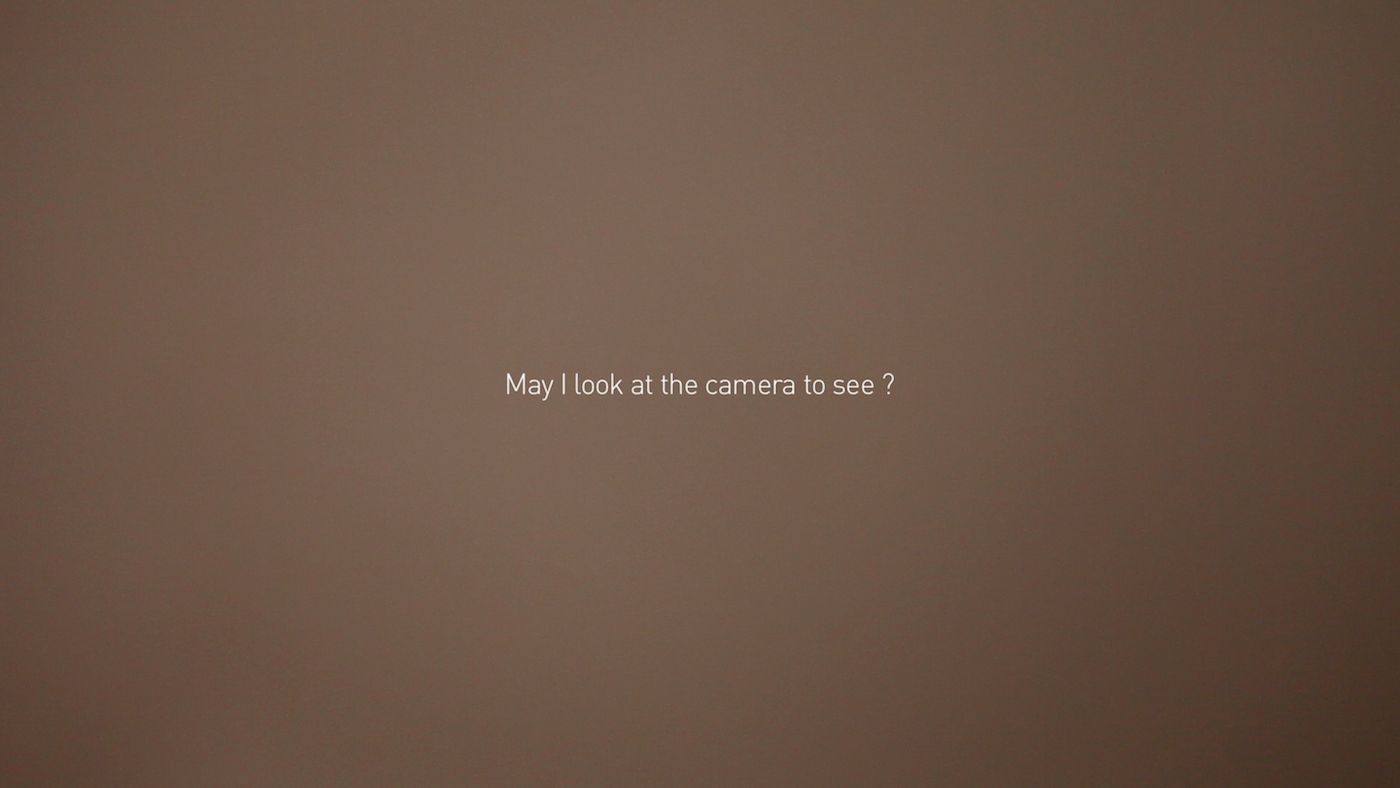
In Foyer (2016), Ismaïl Bahri reconstructs the process of image-making by using a camera to produce a different space. The 31-minute film begins from a simple but radical gesture: to interfere with what the camera is supposed to show. Bahri physically intervenes in the image-making by placing a white sheet of paper in front of the lens of the camera. The tools and the angles are the same, but there is an obstruction. In this film, the sheet gently moves as the filming appears to be outdoors, recording and revealing shifting daylight and winds. Over the course of the film, conversations between the filmmakers and passersby in Arabic are reflected as subtitles placed in the middle of the screen in English. Sound and language begin to carry more weight than the image itself.

Bahri sets up the premise of the film within the first few moments, transitioning swiftly between rapidfire conversations as the viewers settle into the experience of eavesdropping. The lack of figures and context strengthen this feeling of listening in on conversations, which serve to reveal just how much we are used to the omniscient position of the spectator. We take for granted how much we get to see and Bahri’s film foregrounds this desire by showing us much less than what we are accustomed to seeing. Bahri’s positioning of the viewers as such is further complicated by a brief moment in the film when the image goes dark, but the viewers can still hear the conversation. We quickly realize that the filmmaker is having a conversation with police officers who question him about why he is filming and as Bahri talks to them, the lens cap is placed on the camera. This second physical intervention in the making of this film, executed by Bahri as demanded by the police officers, discloses the circumstances of a filmmaker using a camera in public space to talk to the inhabitants of that public space about the very presence of that camera, which contradicts and thus exposes the surveillance mechanisms in the space. The film no longer documents surveillance, it becomes entangled in it. This moment is in contrast to another brief moment when the sheet is almost fully lifted by the wind and we get a glimpse of where Bahri is in a public square with trees, benches, and a few people. Bahri dismantles the surveillance mechanism by pointing to the absurdity of his inability to film nothing; the conversations that populate the film thus become the imageless protagonists of this film, drawing the viewers’ attention to who populates the public space and what they are actually worried about through the ruse of a camera with a sheet of paper blocking its view.

Bahri’s film creates a space that is clearly distinguished from the space of surveillance by showing next to nothing visually. He traces the boundaries of what a moving image is, denying viewers that image. Bahri’s film is an exercise in what happens when we cannot see, to discuss when we do not see or just how much we are used to seeing.

By withdrawing recognizable images and narratives from the film, Bahri points to the absurdity of what takes place in public spaces that have become increasingly limited around the world, and the inherent violence of these spaces. As viewers, we latch onto the slightest of movements in the image and the conversations that take place diegetically come into hyperfocus. Bahri’s physical presence in the public space becomes a contraption—the film is no longer about what is seen through the camera but it is about the camera’s presence. Hence, the camera itself becomes the subject of the film.

By exposing the mechanisms with which we get to see what we see, Bahri reveals the aesthetics of politics—are we ready to see how little politics are actually practiced in the public space? Bahri’s white sheet in front of the camera and everything that happens around that camera is an amalgamation of aesthetics of politics, a jarring absence.

Politics as aesthetics

Trinh Minh-ha’s Reassemblage: From the Firelight to the Screen (1982)[2], a forty-minute film that converges her footage from Senegal and a voiceover narrated in her voice, includes a myriad of strategies with which she deconstructs the relationship between her as a cultural translator, the person making and narrating the film, and her Senegalese subjects. In her fragmented voiceover, Minh-ha keeps repeating that she does not speak about Senegal, but instead speaks nearby Senegal. This repeated statement serves three purposes: The first is that the distance between the subject of speaking and the subject speaking is acknowledged and included in the statement through the adverb of nearby. The usage of nearby hints at all the distances between speakers and their subjects and whether such distances are overtaken by the speech or not—nearby necessarily includes its antonym and is thus embedded in the space between the speaker and the subject. The second is that the distinction between “speaking about” and “speaking nearby” undermines the authorities assumed in speaking about a place, a people. By making this distinction, Minh-ha separates her speech from other speeches, recognizing not only the impetus to speak about but also that the refusal to do so is possible. In this case, silence or refusal becomes an ethical position. The third and perhaps formally and conceptually most significant purpose of this statement is that by repeating this statement multiple times, Minh-ha subverts the voiceover text itself. Through repetition, the statement becomes incantatory—a self-soothing attempt to loosen the boundary between speaker and subject.The speaker and the subject occupy the same space without forming an elucidating relationship. The viewer is included in this porous narrative space; we are not spoken to or addressed—we are just there. The artist speaks and continues her speaking as she narrates, reinforcing the sense that her speech is an ongoing act. The time here is layered rather than linear—the past existing in the present as it will exist in multiple forms into the future, a touching and co-existing temporality.

Minh-ha also notes the “omnipresence” that could refer to the eye or the I. The ambiguity between the “eye” and the “I” in spoken language is precisely what Minh-ha’s assemblage allows viewers/listeners to do in this instance: the eye that we expect to speak for and present the I is left ambiguous so that the viewer can disassociate the two: where there is an I, an eye emerges to produce the eye that appears to speak for Is. [1] [2] 

3

Minh-ha’s assemblage of images around Senegal acknowledges her tenuous relationship with the place, reinforced by the repetitive, fragmented editing of the footage, employing numerous vantage points that serve to dislodge the position of the documentary filmmaker as a stable, all-seeing, authoritative eye. Minh-ha’s footage appears to meander as if she collected footage with a curious eye, returning to certain elements that she found interesting. The ambiguity or nebulousness of her point in making the film foregrounds the act of looking, scrutinizing herself to a fault, drawing on the imminent dissolution of any assemblage, which necessarily and inherently hosts a reassemblage.

Minh-ha’s reassemblage as a method internalizes the logic of the politics she practices as a filmmaker. The film begins with a black screen with sound slowly seeping into the image as if to remind the viewer that Minh-ha builds her image—things are not just seen or observed, but they are constructed, spoken. In Reassemblage, the politics of filmmaking, of anthropological observation and recording, become an aesthetics, a sensibility with which relations are built and attuned to.

Aesthetics as politics

Patty Chang’s The Product Love (Die Ware Liebe) (2009)[1], a two-channel video installation, is in constant movement. The artist situates the work in multiple arcades: languages (German, Chinese, and English), modalities (porn, live translation from one language to another, conversation), transformation (through make-up and dress, transitioning from one person to a make-believe version of someone else). The two-channel presentation of the work adds another layer to this structure. One channel presents three academics translating a 1928 article by Walter Benjamin, A Chinoiserie Out of the Old West, in which Benjamin recounts his encounter with the Chinese-American actress Anna May Wong. The poetic prose of this text is challenging to translate as each academic stumbles over words and syntaxes, unpacking Benjamin’s words in copious words and sentences, explaining as they go along what a phrase could also be articulated as in the target language. The very act of live translation as they read out loud and formulate their translations accentuates the necessarily imprecise nature of translation. Comprehension of Benjamin’s words occurs simultaneously with the transition into another language, moving over sentences, syntaxes, words, and affects. The relative unease of this act seen performed on the screen opens up the space of translation: as the translators struggle to transfer the meaning of the work they are translating fully, the attempts reveal that there is more to the work than the words.

The fickleness of translation is accentuated further in the second channel of the work, which hinges on a mistranslation: in the original conversation between Wong and Benjamin, Benjamin asks Wong what she would do if she could no longer make films. Wong says, “touch wood,” which is recorded as “touch would.” Wong’s apotropaic gesture fails translation. Chang builds on this mis-transfer to have two actors who are conspicuously and somewhat ridiculously made up as Benjamin and Wong to become intimate in front of the camera. This feigned intimacy of “touch” is not a caricature of a mishap—it is a translation. Chang’s work functions as an embodiment of a translation that cuts across languages to reckon with an intersubjectivity that exists between temporalities, histories, languages, people, and places. The stand-ins for Wong and Benjamin are touching the original Wong and Benjamin, as Benjamin’s original work touches the translations on camera, as the feigned intimacy on camera touches authentic intimacy off camera. Chang’s work The Product Love (Die Ware Liebe) translates and is constituted by translations: Chang points to translation as a method that operates in-between objects and subjects, necessarily and urgently unstable in its effects and affects.

4

Chang’s work is anchored in pairs of languages, people, and screens. This shiftiness between things, the uneasiness, the unstable ground on which the work stands conceptually and formally, points to a version of politics that is embedded in aesthetics. A politics that does not dwell in aesthetics, but rather is implicated by it. A politics that can breach aesthetics to substantiate moments of possibility. A politics that is both demanded and propelled by aesthetics.
 
Trying to translate “estetik politika” as “aesthetics of politics”, “politics of aesthetics”, “aesthetics as politics,” and “politics as aesthetics” stems from my deeply held belief that in our current moment of intersecting, unfolding, ongoing collapse and crisis, questioning while not shying away from loaded terms such as aesthetics and politics is vital. In situating ourselves and our practices in relation to these terms and its various renditions, we can begin to understand them as essentially dynamic yet necessary tools of communication that can help us relate to each other and to the world writ large. Artmaking is a deeply personal and ultimately public pursuit that makes visible, audible, sensible that other worlds, other relations, other entanglements are possible. This potential to make available what was previously withdrawn is an aesthetic pursuit liberated by the political. “Estetik politika,” in its many translations, names a practice of moving across forms, relations, and worlds without stabilizing them.

References and Notes

[1] If I were to translate the term exactly as is, it would read “aesthetics politics.” Turkish is a suffixing language with an agglutinative morphology. The most conventional translation of the term would be “politics of aesthetics,” prioritizing politics, which as the latter word could be interpreted as the protagonist. Translating it as “aesthetics of politics” would be less conventional and the translations using “as” to connect the terms are speculative translations on my part.
2 Lydia H. Liu, Translingual Practice: Literature, National Culture, and Translated Modernity—China 1900-1937 (Stanford: Stanford University Press, 1995), 1. 
3 Umachandran, Shalini. 2018. “Art Cries off the Wall.” LiveMint, May 4, 2018. https://www.livemint.com/Leisure/TyPpfseWKWQ004fu6fdnhO/Art-Cries-off-the-wall.html.
4 Aparna Sharma. “An Arrested Eye: Trauma and Becoming in Desire Machine Collective’s Documentary Installations” in Documentary Films in India. (London: Palgrave Macmillan, 2015), 125.
5 Ibid., 125
6 Ibid., 128
7 Ibid., 127
8 Ibid., 128
9 https://mubi.com/es/notebook/posts/ismail-bahri-introduces-his-film-foyer
10 Trinh T. Minh-ha, Reassemblage: From the Firelight to the Screen (Wychoff, New Jersey: Women Make Movies, 1982). 
11 https://jeudepaume.org/en/evenement/reassemblage-trinh-t-minh-ha/
12 Patty Chang, The Product Love (Die Ware Liebe), 2009. Two-channel digital video installation, 42 min. Solomon R. Guggenheim Museum, New York, https://www.guggenheim.org/artwork/26179.
13 https://www.guggenheim.org/artwork/26179