A space to see

Letter to Cécile Poblon and Olivier Marboeuf


A letter from Ismaïl Bahri to Cécile Poblon (director of the BBB Art Center in Toulouse) and Olivier Marboeuf (director of the Espace Khiasma in Les Lilas) as part of the development of the artist’s monographic exhibition, which was presented in September 2014 at the Espace Khiasma and on the occasion of two Phantom Mondays: April 10th at the Magin Cinema in Bobigny and April 14th at the Espace Khiasma in Les Lilas. 


Journal Phantom n°5
2014

Link to the exhibition sommeils
Link to the letter


ismail-bahri-croquis-dessin-2024-1.jpg
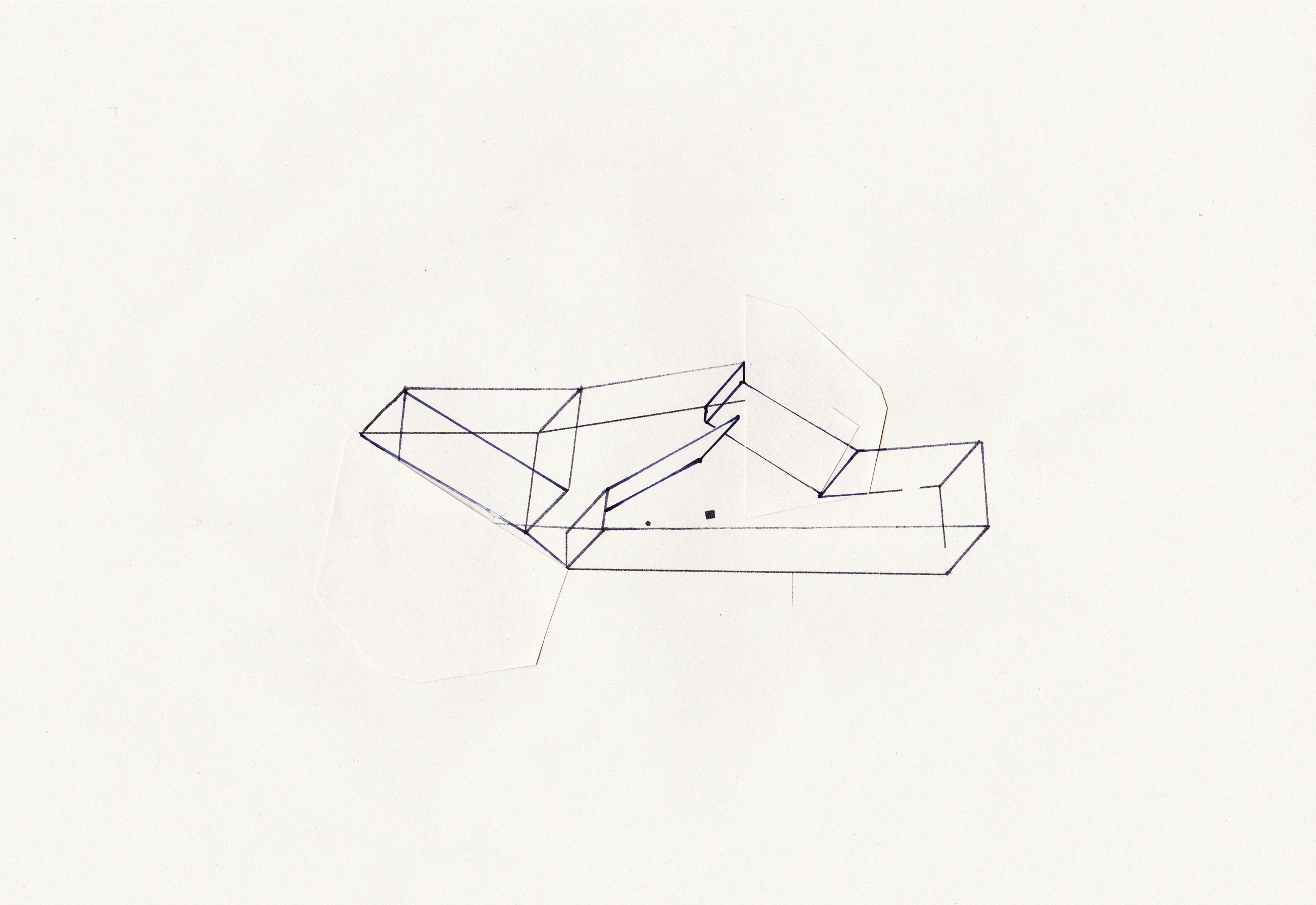
Ismaïl Bahri, sketches, drawings, 2014

PERCEES  (APERTURES, OPENINGS)

Dear Cécile and Olivier,

Before we meet again for the next Phantom Monday, here are a few notes on the latest elements I’ve been thinking of. I’ve added a few sketches from my notebooks, as well as an excerpt from lecture notes.

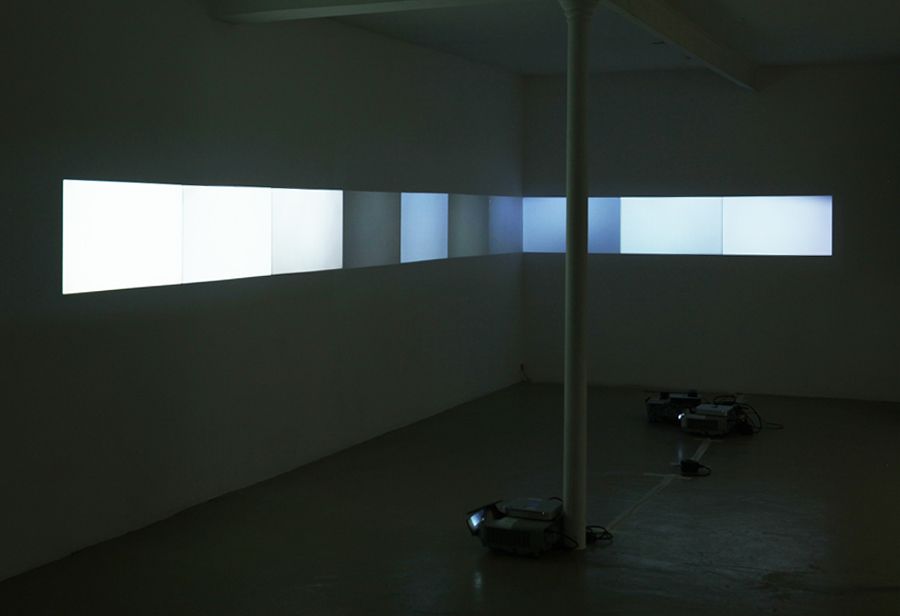
The first room will be large and in semi-obscurity. The videos projected here will show windows of different sizes. Openings onto one or several spaces. Onto elsewhere(s) difficult to describe. It will be a minimalist viewing room where we will see an elementary installation, reduced to an almost abstract dimension, not to say Suprematist. Simple dark squares — in the same tone as the projection wall — that float and allow infinitely small openings of light to pierce through. The title will be Percées (Apertures, or Openings).

Sketches. The projection of Percées could also be envisaged on the scale of a wall or a movable partition. The space would create a sort of large optical chamber, with the wall or partition functioning as a shutter. Alternatively, the wall-shutter opens and closes, sometimes allowing light to pass through and sometimes obstructing it and becoming a simple wall again. On an architectural scale, a cinematic-photographic mechanics is convoked, with its intrinsic elements: screen, shadow, apparition and mechanical palpitation.

***

When the spectators enter the exhibition, they will penetrate into obscurity, in order to be exposed to lights (both to the interstitial lights emanating from the apertures as well as the continuous light of the video projectors).

The exhibition project revolves around the functioning of elementary things transformed into sensitive intercessors. It also activates the elements—essentially, the wind—invoking them as vectors of circulation and dissipation of matter. Light, emanating from tiny chinks in the walls — whether real or fictive (as much as illusory?) — penetrates the room. These infiltrations are sometimes very minimal and reveal little. The apertures of light sometimes disappear. I would like to find a way to give the impression that what is activated is very simple. I’d also like to reserve an important place for the site’s ‘breathing’, in particular at the level of its architectural limits.
ismail-bahri-croquis-dessin-2024.jpg
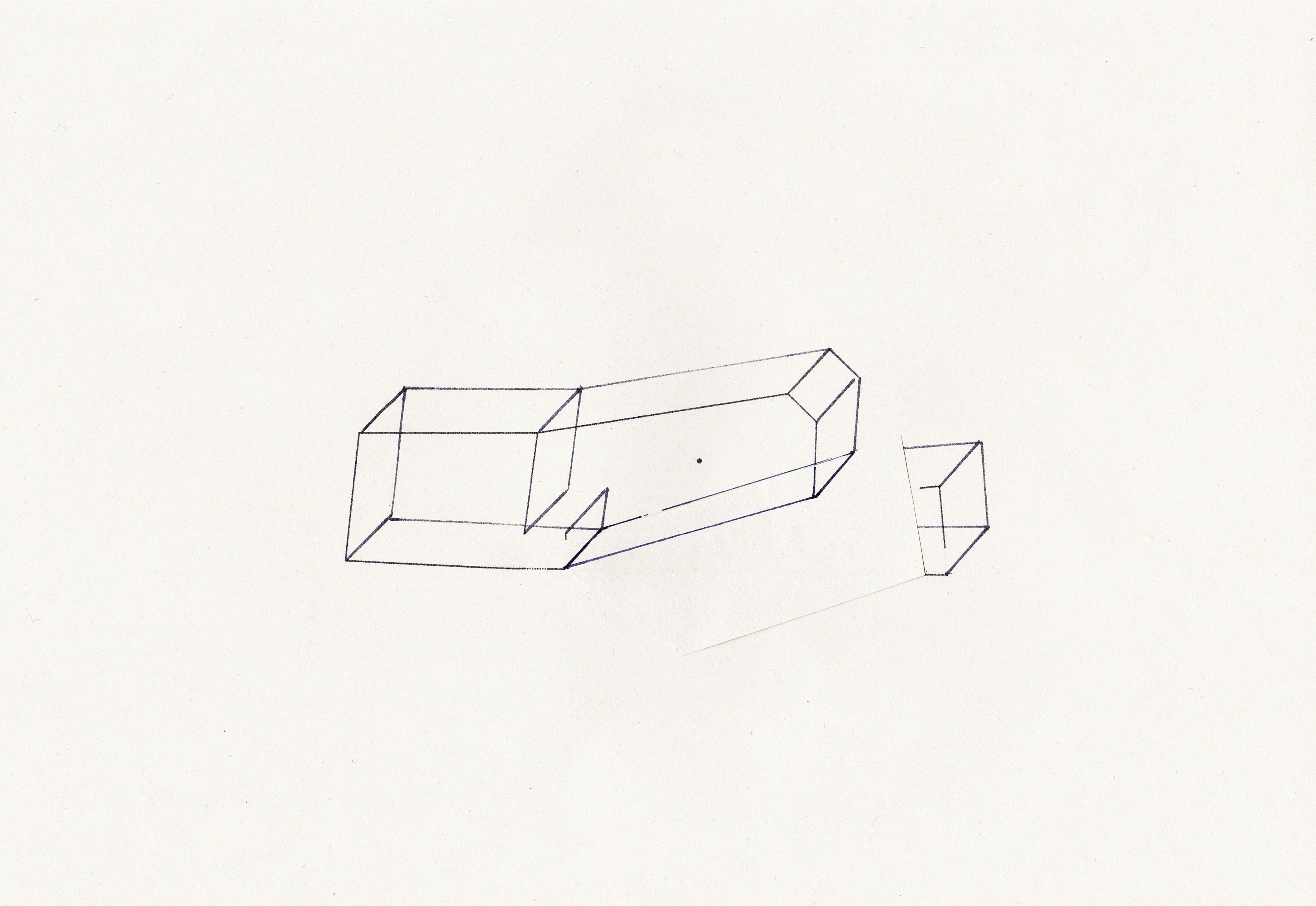
Ismaïl Bahri, sketches, drawings, 2014

A common denominator in my current research: palpitation, which rhythms the circulation of the elements. This palpitation is found in the luminous flashing and slight trembling of surfaces and membranes. The palpitations are temporal markers. Through the intermittent rhythm of the flashing, they play on the interval that separates the apparition and disappearance of two images, two events, alternating what is revealed and what escapes from the audience’s view.

The physical limits of the exhibition site will be treated in such a way as to create diverse spaces for passages (movements) and projections. The idea of the opening, or aperture, touches on this. It carries in itself the idea of the ‘opening’ as a breach that allows an infiltration from outside. The light that filters through and the motifs that are filmed evoke the existence of the ‘hors-champ’, or ‘out-of-range’. This ‘hors-champ’ is multiple and imagined. The landscape that can be perceived behind the paper mask remains vague and distant. A body? Several bodies? A crowd? A city? A natural landscape? Another country? It’s possible to retain certain signs or indications of the place and its geography, but this Elsewhere should emerge as somehow troubling to the viewer. And here we come to an element that I find essential: breath. Coming and going, opening and closing, pulsations. Matter pulsates, the walls unfold and vibrate, their movement indicating a current of air.

***

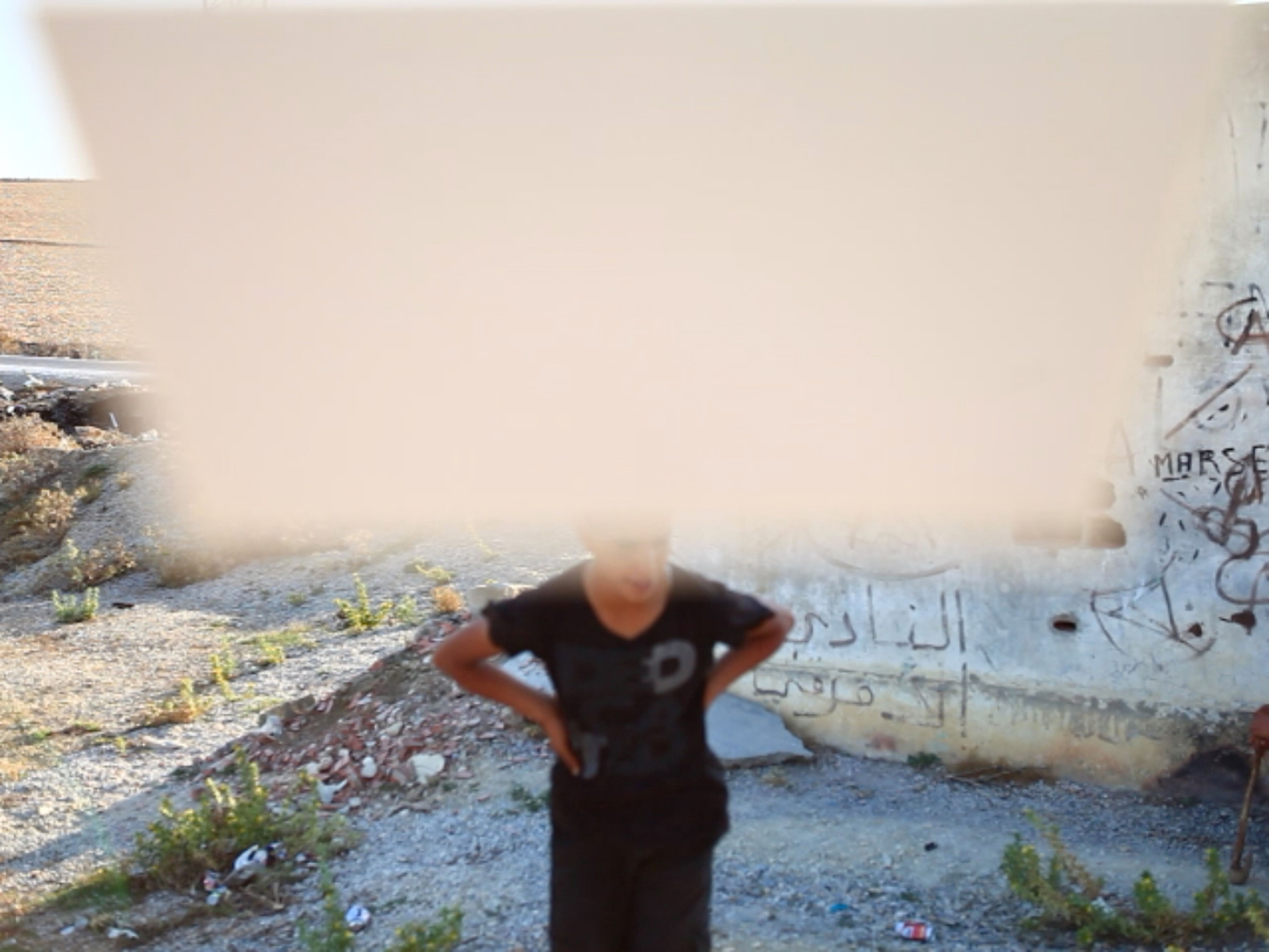
Reviewing the rushes to be used for Percées, it came to me that the black ‘cache’, or mask, is a sort of shadow falling across the image and ‘clothing’ it in a haunting. This shadow soon made me think of a ghost, but later I felt I could understand its true nature. The shadow convokes the ‘hors-champ’ of the image, into the image itself: in other words, the viewing room, plunged into darkness [1]. As if the obscurity of the “cinema” contaminated the image at its center, covering it almost entirely, allowing only tiny chinks of light to pierce through. A bit in the manner of an internal parasite, or black hole.

Eclipses seems to be the logical flip side to Percées. In the same way the screen is the companion piece to darkness. Each of these experiences is the complementary reverse of the other. Eclipses is the projected light of Percées and Percées is the projected shadow of Eclipses. And the title of each of these pieces convokes its double. Percées indicates light while Eclipses presupposes shadow.

In this sense, using dark masks is a means of having recourse to negatives of lights, to sensitized surfaces burned by light. Conversely, using white masks is similar to exploring the excess of light, the over exposition of the image.

DEMNA / KHIASMA

On my last trip to Tunisia, I returned to Demna, to the place where I filmed the adolescents last summer. The landscape had become green and the ground muddy. I returned several times to roam around the small dilapidated and graffiti-ed building that we see in the rushes from the summer. I still don’t really know why, but this site attracts me. Going back again and again, I began to note certain rituals. The school bus passes by two times every morning, a tank truck travels through twice, to make a U-turn. The building is used as a bus stop and the residents of the village stand in its shadows to protect themselves from the sun. The people I met told me that the structure is going to be turned into a real bus stop, when the route is repaved. I’d noticed the first indications of a work site in preparation: a pile of gravel, traces of a backhoe in the mud. There’s a risk that the landscape will be drastically transformed.

SITES OF FABULATION AND MEMORY

I wander around this site, even as I am haunted by another site: the Espace Khiasma. Each of these spaces becomes the projection of the other. I feel as if this spacing/rapprochement will be a central element in the exhibition I’m preparing.

Olivier, at the last Phantom Monday, you spoke of fabulation. There was a question of the fabulation of sites, the fabulation of Tunisia as the sensitive entanglement of spaces, bodies, atmospheric and mnemonic elements. And that is true. But the exhibition project will also be created around the potential decanting between the Espace Khiasma and these projected spaces. With the screen functioning as hinge, each of these spaces encounters a reverse side, another site.
 

ismail-bahri-eclipses-2013-5-300dpi.jpg


GETTING BACK TO THE BEGINNING OF THINGS

I’ve made editing tests with the rushes from Eclipses. The editing work has the particularity of depending directly on the elements: light, wind…the ghostly things that traverse the range of the camera and contaminate the internal construction of the film.

Eclipses could generate a series of short videos, to be seen in a loop, with no identifiable beginning or end. Each of these videos would try to encapsulate a bubble of time, a certain light, a certain wind, encounters; what happens. Each would be the beginning of a film, the beginning of a potential narrative. But they would go no further than that — limited to few minutes, a few pulses — a beginning, no more.

Generally, the ellipsis serves as a way to bypass dead times, to jump from event to event. Here, the ellipse becomes the crux of the film, with its lengths, its latencies and perpetual beginnings.

With the recourse of editing, I hope to abandon the several screen format that I had originally planned on. I would like show these little films on plexiglass screens that float in space. These screens would be of middling size (approximately 60 cm wide). Translucent and two-sided, they would echo the idea of a hinge pivoting in space.
 

ismail-bahri-horizons-installation-video-2014-espace-khiasma.jpg


CREATING HORS-CHAMPS

The projection can play on the idea of wall surface/screen—to think of the exhibition in terms of the potential (and magical) transformations of the site. With the idea that the exhibition could change our perception of the space.

I’d like to imagine the screens to be trembling and the blank films as the sensitive fabrication of spaces—as in the organization of segments of shadow and light, of holes, chinks, openings, closings. To remove certain partitions and add others, to create gaps, reveal doors and windows, or to hide others in certain cases. A plethora of openings towards other possibilities: to sensitize the viewer, through the reformulation of the space, to the question of potential ‘hors-champs’.

To a lesser extent, there is also the idea of creating an ‘hors-champ’ of the cinema itself, “that obscure part of the field” as Jean-Louis Comolli described it. I would have to fabricate darkness, shadows, with their angles, corners and textures [2].

A HOLE IN LIFE

“Time is compressed or suspended inside a cinema, which puts the spectator in an entropic state. Spending time in a cinema is like making a hole in one’s life” [3].

“What’s happening at the edges constitutes the exact place where seeing occurs” [4]. Reading these words I remember what Martine Markovitz said at a Phantom Monday, watching Film à blanc: “you see nothing”. The suppression of the negative expresses well the idea of an emptiness placed at the center. White, or the blank of an absence of images, acquires a centripetal force. But I have the impression it is also what is projected onto the edges. Paradox of a central emptiness that consumes as much as it pushes out towards the edges.

George Didi-Huberman sees in the work of James Turell the “littoral, (or coastal) conditions of the visual experience”, a “sight from the edges” or “borderline”. A littoral vision: what might that be?

***

According to Truman Capote, Gauguin, Van Gogh and Renoir must have used black mirrors (or Claude glasses) to “refresh their vision”, to “renew their reaction to color and tonal varieties. After long periods of work, they rested their tired eyes by looking at these black mirrors” [5]. It’s at this junction that the video Orientations intersects with the experience of Film à blanc. The black mirror, which shows us “the light of an eclipse”, rests us from seeing and convokes the intuition of a peripheral visual search. Exploring a city with your eyes gazing into a black mirror, just like filming an eclipse of sight, would be like focusing on such moments of visual refreshment, sliding into the shadow of rest.

Blinking one’s eyelids creates fleeting apertures. Apparently, it is the body’s softest contact.

***

I recall what Simon Quéheillard said about Eclipses: “I have the feeling that it concerns a revelation that is less a moment of opening and relief than a sort of control or constraint, as if you didn’t want the image to exist, in the way a filmmaker would start a reel of film with the objective of only filming what happens between the exact beginning and the very first image. We’re somewhere in between, in a film that could be reduced to two photograms.” This idea of a film compressed into two photograms pleases me. The “inter-image” separating two photograms makes me think of a video recording in which Comolli evokes the place “of absence” [6], the ghost element that haunts all film. Hearing him, you realize that the cinema carries in itself, physically, a great place of emptiness, that it is made through, or with, its absent part. You realize that an invisible film hides in every film.

As Rodolphe Olcèse commented to me, it is perhaps this gap or lack, which is disappearing with the advent of the digital, that I seem to be replaying. In the same way that this system convokes the accidents, or lack of control, that the digital image tries to banish.

In Eclipse, the swinging movement of the paper membrane troubles the plenitude of the illusion, interrupting our attention from the screen and breaking up the flow towards the depth of the image. The representation, this sensation of being cut off from the world, this ‘hole in life’, is disturbed by each beat of the hinge. Breaking up the continuity of the image may be nothing more, perhaps, than a way of bringing us back to the real (and to sensitize us to the frame and the ‘out of frame’.) In the long run, it’s the palpitation of the hinge that become the principal object of observation (and the image on screen its ‘hors-champ?’.

ARCHEOLOGY OF CINEMA

To imagine a form of archeology of cinema is to move back to the moment when filming was a question of flesh. Flesh in the place of an avid and surprised response to the magic force of the projection, to the apparition of the image. The flesh of a gesture invoked by a desire for experimentation and a will to learn.

To learn by doing. I realize that it is impossible for me to disassociate creation from a form of apprenticeship or re-apprenticeship. Constructing this installation means conducting a simple experiment, replaying the role of the operator-inventor who cobbles together his tools at the same time as he asks himself how he will use them.

THE INSTRUMENT AND ITS WEAKENED DOUBLE

The shutter device grafted onto the camera lens is a crude counterpart to the internal machinery of the camera (and more generally of the device for cinematographic capture). It is almost as if it was the extraction of what, on the inside, makes the tool work. This extraction is a first projection.

Compared to the internal electronics of the camera, this hand-made extraction is much less precise or sophisticated — obviously — which is why, I believe, it offers a form of weakened double. A little bit like a small model that shows an alternate counterpart to the real; this other version reinterprets, with a form of incompleteness, the camera-tool I use, freed from all organic knowledge.

ROBERT BRESSON

“Build your film around the white, the silence and immobility” [7].

DESISTANCE OF “BLANK FILM”

Derrida’s ‘désistance’ [8] intrigues me. I see a way of projecting oneself in a movement of retreat. 

To go out in the street and film a demonstration with no film (filmer à blanc), is to make contact with the world while exercising restraint. Integrating a crowd on the march so as to film it on the sly is, in a way, to enter into ‘desistance’. This relates, perhaps, to “the incompleteness of positions” that you evoked at the last Phantom Monday.

***

‘To The Distant Observer’ comes to mind, a text on Japanese cinema that evokes the first film projections that took place in Japan. Seats for these projections were sometimes positioned parallel to the lights of the projector, so that the audience could observe both the luminous beams and the image projected onto the screen. In this configuration, the spectator also adopts the point of view of the observer and situates himself in an incompleteness of positions. Not exactly a spectator, not exactly an observer, both distant spectator and ¾ observer, a person thus situated in a cinema sees the image arrive. He observes the cause at the same time as the effect.

DAY

Sketch: a brick wall is built at the Espace Khiasma. It blocks the passage to part of the space — the ‘salle noire’ or black space used for film projections. This wall contains interstices, spaces between the bricks through which the rays of a projection filter. A title came to me for this beginning of an idea: Day.

A film comes to us from this inaccessible reverse place. It filters in through the wall. It becomes a dissipative element, appearing bit by bit, disassociated from part of itself. Building this wall in the ‘salle noire’ will be like confining the room, but in fact, more like turning it in on itself. The projector will be moved and will be positioned at the exact opposite place from where it is now. The room’s orientation will change.

PROJECTIONS

The space, via its architecture, is occupying more and more place in the project and the wall becomes a recurring element: it allows for jumps and breaks in spaces, it can be the support for a projection or serve as shutter. It also allows us to regulate distance with images and screens.

Day: this wall will perhaps be painted white, so that it blends in with the rest of the space. This fusion will redefine the space because it will reduce the total volume by about one-fifth. But I think this obstruction will actually open up the space. For in the same way that an amputation reveals a phantom limb, I suppose that removing the ‘salle noire’ will convoke its haunting. Removing this room from vision and the body will make it the ideal receptacle for mental projections, a space for suppositions.

Another architecture, another place: this brick wall brings to mind the little structure in Demna. Abandoned, dilapidated and poorly constructed, the walls of the structure allowed you to see through cracks out on to the landscape beyond. I see myself associating this architecture more and more to a box for writing and projection. Something here contains the kernel of the coming exhibition. The ‘salle noire’ at the Espace Khiasma could become a companion piece to the site in Demna. They are about the same size and I imagine have the same tendency for confining and opening.

***

For the upcoming Phantom Monday, I’m currently making sketches on the blueprints of the Espace Khiasma. I sketch, articulate sections of wall, remove others and create holes in the plan. For the moment, I’m searching: this little drawing in three dimensions should be examined and unfolded the way you fold and unfold a box.

CREST OF VISIBILITY AND ACCOMMODATIONS

Day, Eclipses, Apertures and Blank Film, but also OrientationGhost line and Attraction. All of these research projects are situated on the edges of perception, on the level of a “crest of visibility”. Eric Degoutte used those words. A crest of visibility that he registers in a ‘process of accommodations’ to things and to the real.

Accommodation interests me because of the adaptation movement it supposes. I think that accommodation accompanies the passage from shadow to light, for example. A slow transition, the experience of the interval, the accommodation covers the precision effort, the adjustment to what surrounds it. It therefore presupposes a length: it’s the development of an attempt to see.

Olivier, this discussion found its double on the day when you and I were considering the space at Khiasma, and you said the following about the September exhibition: “to manufacture a space to see”. By imagining all the different ways of transforming the space, the idea became more clear to me: to manufacture a place that serves to frame/re-frame, to open and close horizons.

Aperture and Day: in both cases (but in a different way), the wall is associated with film, to the sensitized membrane. The wall becomes a torn, cracked screen, a permeable surface that lead to elsewhere(s). It is what separates as much as what links; an accommodation element between the real and the intercessor of the real to the image.

MAKING VISIBLE

I would like to include in the upcoming exhibition a work that is important to me, the video One second of silence by Edith Dekyndt. The video shows a transparent flag floating in the sky, waving in the wind. The flag works like a window in the image. The plastic material of the flag, flying over the landscape, catches colored and luminous nuances. Welcoming this video into the exhibition would be like creating another opening in the space, and drawing a precious horizon.

One second of silence is one of those pieces that I would have liked to have made, one of those works that I look at regularly and that I think of often. At a given moment, I said to myself that it could have been one of the possible outcomes of my current research, but in fact, it is more correctly one of its origins. This video has a place in what I am trying to do. It is part of a history in the same way that the gesture of welcoming it prolongs another gesture: that of Edith Dekyndt to Robert Dasché a few months ago, when she showed one of his films in her exhibition. My inviting Dekyndt’s video is the continuation of this gesture by another and for another. And within the gesture another dynamic attracts me: making visible. I want to continue this gesture because it participates in the creation of a ‘space for seeing’ that I dream of.

In a different but similar way, it is in the same spirit that I invited you to join us in these exchanges, Cécile, and to participate in the next Phantom Monday. I wanted to invite you for several reasons. In part because as I watched you work (from afar), I appreciated your way of trying to maintain a long term work relationship with artists, which is rare. But also because at our first meeting, you spoke to me of the importance for you of composing your exhibitions in the manner of research. That is to say with an attentive follow-up of the artistic research in progress and attention given to the spaces and exhibition formats that are a result of that research. And it is this dynamic that I found in the exhibition you created with Guillaume Pinard for VANDALE. I believe that this discussion is one of the sparks of that project.

TRANSPORT OF DOUBTS

I’ve noticed in my readings that film projection is often described as being a transport of an image. It might be better said that it is the transport of a doubt. Doubt is something that is beyond me, but I use the word because it engenders a relation to the enigmatic and the magical that touches me. It presupposes, in other words, creating a space that won’t reveal itself initially but will produce, in the period of accommodation, a floating or hesitation in relation to what is about to happen. I am clearly making a link here with the exhibition Mandrake a disparu, which tried to see the projection as the transport of doubts. I want to pull on this string from Mandrake a disparu and use it as one of the themes for the upcoming exhibition.
Un espace pour voir

Lettre à Cécile Poblon et Olivier Marboeuf


Lettre d’Ismaïl Bahri à Cécile Poblon (directrice du centre d’art BBB à Toulouse) et Olivier Marboeuf (directeur de l’Espace Khiasma aux Lilas) dans le cadre du développement de l’exposition monographique de l’artiste qui sera présentée en septembre à l’Espace Khiasma et à l’occasion de deux Lundis de Phantom, le 10 avril 2014 au Magic Cinéma de Bobigny et le 14 avril 2014 à l’Espace Khiasma aux Lilas.  


Journal Phantom n°5
2014


Lien vers l'exposition sommeils
Lien vers la lettre


ismail-bahri-croquis-dessin-2024-1.jpg
Ismaïl Bahri, croquis, dessins de recherche, 2014

PERCEES

Chère Cécile, cher Olivier,

Avant de nous retrouver dans quelques jours pour le Lundi de phantom voici quelques notes sur les derniers éléments qui me sont venus à l’esprit. J’y rajoute quelques croquis prélevés de mes carnets ainsi que l’extrait de prise de notes de lectures.

La première salle serait une grande chambre à l’obscurité douce où chaque vidéo donnerait à voir des fenêtres de différentes tailles. Autant de percées ouvrant sur un ou plusieurs espaces. Sur des ailleurs difficiles à définir. Ce serait une chambre à images minimaliste où on verrait un dispositif élémentaire réduit à une dimension quasi abstraite, pour ne pas dire suprématiste. De simples carrés obscurs - de la même teinte que le mur de la salle de projection - flottant et laissant percer d’infimes ébrasures lumineuses. Le titre en serait Percées.

Croquis : la projection des Percées pourrait également se faire à l’échelle d’un mur ou d’une cimaise. L’espace ainsi travaillé donnerait forme à une sorte de grande chambre optique avec le mur comme obturateur. Alternativement, l’obturateur-mur se soulève et se ferme, tantôt il laisse passer la lumière et tantôt il l’obstrue pour redevenir mur. A l’échelle de l’architecture, c’est la mécanique ciné-photographie qui est ici convoquée avec ses éléments intrinsèques : l’écran, l’ombre, l’apparition et la palpitation mécanique. 

ismail-bahri-croquis-dessin-2024.jpg
Ismaïl Bahri, croquis, dessins de recherche, 2014

Ouvrir l’exposition se ferait comme on pénètre un dispositif optique. Le spectateur percerait l’obscurité pour y être exposé aux lumières (à celles, interstitielles, émanant des percées autant qu’à celles, continues, des projecteurs vidéo).

Le projet d’exposition gravite autour de choses élémentaires transformées en intercesseurs sensibles. Il active également les éléments  - essentiellement le vent - qu’il invoque comme vecteurs de circulation et de dissipation de matières. Provenant de petites brèches réelles ou fictives (autant qu’illusoires ?) de la lumière pénètre le lieu par les murs. Ces infiltrations sont parfois discrètes et donnent peu à voir. Les ébrasures de lumières quelquefois s’éteignent. J’aimerais arriver à donner l’impression que ce qui s’active ne tient à rien. J’aimerais aussi réserver une grande place à la respiration du lieu, surtout au niveau de ses limites architecturales.

Figure commune aux recherches actuelles, la palpitation rythme la circulation des éléments. Cette palpitation se retrouve dans le clignotement lumineux et dans le tremblement infime des surfaces et des membranes. Ces palpitations sont des marqueurs temporels. Par la rythmique intermittente du clignotement, elles jouent sur l’intervalle séparant l’appariation et la disparition de deux images, de deux évènements, alternant ce qui se donne à voir et ce qui échappe aux yeux du public. 

Les limites physiques du lieu d’exposition seraient travaillées de façon à y créer divers espaces de passages et de projections. L’idée de la percée recouvre cela. Elle porte en elle l’ouverture comme brèche permettant l’infiltration du dehors. Les arrivées de la lumière et des motifs filmés évoquent l’advenue du hors-champ. Ce hors-champ est multiple et fabulé. Le paysage qui se devine derrière le cache en papier demeure imprécis, lointain. Un corps ? Des corps ? Une foule ? Une ville ? Un paysage ? Un autre pays ? Il est possible d’en prélever des indices de lieux, de géographie, mais il faudrait, dans l’idée, que l’ailleurs s’active en trouble chez le spectateur. On rejoint ici un élément qui me parait fondamental : la respiration. Va et vient, ouverture et fermeture, pulsations. La matière palpite, les murs se déplient et vibrent, la fuite indique l’appel d’air… 

En revoyant les rushs qui serviront à réaliser Percées, le cache noir m’est soudainement apparu comme une ombre tombant sur l’image pour la revêtir d’une hantise. Cette ombre m’a vite fait penser au fantôme mais c’est plus tard que j’ai cru en deviner la nature. Cette ombre convoque dans l’image le hors-champ de cette même image : c’est-à-dire la salle de projection plongée dans l’obscurité [1]. C’est comme si l’obscurité du « cinéma » venait contaminer l’image en son centre, de tout son pan, pour n’en laisser percer que d’infimes lumières. Un peu à la manière d’un dévorateur interne, d’un trou noir. 

Eclipses paraît être le contrechamp naturel de Percées. Comme l’écran est le pendant de l’obscurité. Chacune de ces expériences est le dépli de l’autre. Eclipses est la lumière projetée de Percées et Percées l’ombre projetée d’Eclipses. Et le titre donné à chacune de ces deux pièces convoque son double. Percées indique la lumière quand Eclipses suppose l’ombre. 

Dans ce sens, utiliser des caches obscurs c’est avoir recours à des négatifs de lumières, à autant de surfaces sensibles brulées par la lumière. A l’inverse, utiliser des caches blancs revient à explorer l’excès de lumière la surexposition de l’image.
 

1-ismail-bahri-eclipses-video-2013-300dpi.jpg


DEMNA / KHIASMA

Lors de mon dernier séjour en Tunisie, je suis retourné à Demna, à l’endroit où j’ai filmé l’été dernier ces jeunes venus à ma rencontre. Le paysage est devenu vert et la terre boueuse. J’y suis retourné plusieurs fois pour rôder autour de cette petite bâtisse délabrée et taguée que l’on voyait déjà dans les captations de cet été. Je ne sais pas encore vraiment pour quelle raison, mais ce lieu m’attire. A force d’y retourner, j’ai fini par y repérer certaines ritournelles. Le bus scolaire passe deux fois par matinée, un camion citerne traverse deux fois le paysage pour effectuer un demi-tour. La bâtisse sert d’arrêt de bus et les gens du village viennent s’y protéger du soleil ou s’adosser à ses murs. Les personnes que j’y ai rencontrées m’ont raconté que cette bâtisse allait être transformée en un véritable arrêt de bus en même temps que la route allait être refaite. J’avais remarqué les premières traces d’un chantier en préparation : un tas de gravier, les traces dans la boue d’un tractopelle. Le paysage risque de se transformer.   

LIEUX DE FABULATIONS ET DE MÉMOIRE

Je rôde autour de ce lieu en étant hanté par un autre lieu, celui de l’Espace Khiasma. Chacun de ces espaces devient la projection de l’autre. J’ai l’impression que cet espacement / rapprochement sera l’un des éléments de l’exposition qui se fabrique. 

Olivier, lors du Lundi de phantom, tu as parlé de fabulation. Il s’agissait de la fabulation de lieux, de la fabulation de la Tunisie comme enchevêtrement sensible d’espaces, de corps, d’éléments atmosphériques et mnémoniques. Et c’est vrai qu’il y a de cela. Le projet d’exposition est aussi à fabriquer autour d’un potentiel transvasement entre l’Espace Khiasma et ces espaces projetés. A la charnière de l’écran, chacun de ces espaces recouvre un envers, un autre lieu.

EN RESTER AU DÉBUT DES CHOSES

J’ai fait des tests de montage avec les rushs d’Eclipses. Ce travail de montage a la particularité de dépendre directement des éléments, de la lumière, du vent, de ces choses fantomatiques qui traversent le champ pour contaminer la construction interne du film. 

Eclipses pourrait donner forme à une série de courtes vidéos à lire en boucle, sans début ni fin identifiable. Chacune de ces vidéos tenterait d’enserrer une bulle de temps, une certaine lumière, un certain vent, des rencontres. Chacune d’entre elles serait l’amorce d’un film, du début d’une potentielle narration. Elles s’en tiendraient là - retenues à quelques minutes, à quelques pulsations - au stade de l’amorce.

Généralement l’ellipse sert à contourner les temps morts, à sauter d’évènements en événements. Ici, l’ellipse devient le nœud même du film, avec ses longueurs, ses latences et ses perpétuelles amorces. 

FABRIQUER DES HORS-CHAMPS 

La projection peut jouer du mur surface/écran – penser l’exposition dans les potentielles transformations (magiques) du lieu. Dans l’idée que l’exposition puisse changer notre perception de l’espace. 

J’aimerais penser les écrans tremblants et les films à blancs comme la fabrication sensible d’espaces – comme l’agencement de pans d’ombres et de lumières, de trous, de percées, d’ouvertures, de fermetures. Enlever des cimaises, en rajouter d’autres, créer des béances, et des trouées, révéler des portes et des fenêtres, en dissimuler d’autres dans certains cas. Autant d’ouvertures vers d’autres possibles : rendre sensible dans la reformulation même de l’espace la question de ses potentiels hors-champs. 

Dans une moindre mesure, il y aurait aussi l’idée de fabriquer un hors champ de la salle de cinéma, « cette part obscure du champ » tel que l’a pensé Jean-Louis Comolli. Il y aurait à en fabriquer le noir, les ombres, avec leurs angles, leurs encoignures et leurs textures [2].

UN TROU DANS LA VIE

« Le temps est comprimé ou suspendu à l’intérieur des salles de cinéma, ce qui met le spectateur dans un état entropique. Passer du temps dans une salle de cinéma, c’est faire un trou dans sa propre vie » [3]. 

« L’opération des bords constitue le lieu même où voir à lieu » [4]. Je repense à le lecture de ces mots à ce que Martine Markovitz a dit lors du Lundi de phantom : face au Film à blanc, « on voit rien ». La suppression de la négation exprime bien l’idée d’une vacuité mise au centre. Le blanc, ce blank par absence d’images acquiert une force centripète. Mais j’ai l’impression qu’il est aussi ce qui projette sur les bords. Paradoxe d’une vacuité au centre qui aspire autant qu’elle déporte vers les marges. 

Georges Didi-Huberman reconnaît dans l’œuvre de James Turell les « conditions littorales de l’expérience visuelle », un « regard par les bords » ou « borderline ». Une vision littorale, qu’est-ce que cela peut bien être ? 

Selon Truman Capote, Gauguin, Van Gogh et Renoir se seraient servis de miroirs noirs pour se « rafraîchir leur vision », pour « renouveler leur réaction à la couleur, leur variations tonales. Après une longue période de travail, les yeux fatigués, ils se reposaient en regardant ces miroirs sombres » [5]. C’est à cet endroit que la vidéo Orientations croise l’expérience du film à blanc. Le miroir noir, qui nous renvoie « une lumière d’éclipse », amène au repos du voir, convoque l’intuition d’une recherche se situant en périphérie d’une certaine mise au travail. Parcourir la ville, le regard plongé dans un miroir noir, tout comme filmer les éclipses du « voir » revient à se focaliser sur ces temps de rafraîchissement des regards, à se glisser sous l’ombre du repos.

Le clignotement des paupières crée des percées fugitives. C’est, parait-il, le contact le plus doux permis par notre corps. 

Je repense à ce que m’a dit Simon Quéheillard à propose d’Eclipses : « J’ai le sentiment qu'il s'agit d'une révélation qui est moins un moment d'ouverture et de soulagement qu'une sorte de retenue, comme si tu ne voulais pas que l'image se fasse, à la manière d’un cinéaste qui lancerait la bobine pour ne capter que ce qui vient entre l'amorce et la première image. On est dans cet entre deux, dans un film qui pourrait se réduire à deux photogrammes. » Cette image de film réduit à deux photogrammes me plait. Le renvoi à « l’inter-image » séparant deux photogrammes me fait penser à un enregistrement vidéo dans laquelle Comolli évoque à son propos la part « de manque » [6], la part fantôme hantant toute pellicule. A l’écouter, on réalise que le cinéma porte physiquement en lui une très grande part de vide, qu’il se réalise à travers sa part manquante. Un film invisible se dissimule sous chaque film. Chaque film porte son double affaibli. Double qu’il cache dans ses trous, dans ses interstices.

Comme me la fait remarquer Rodolphe Olcèse, c’est peut-être cette béance disparaissant avec le numérique que je fais semblant de rejouer. De la même façon ce dispositif convoque une accenditentalité que l’image numérique cherche à bannir. 

Dans Eclipse, le basculement de la membrane de papier vient troubler la plénitude de l’illusion, couper le regard halluciné par l’écran, hacher le mouvement de perdition dans la profondeur de l’image. La représentation, cette coupure du monde, ce - trou dans la vie -, est troublée à chaque battement du clapet. Hacher ainsi la continuité de l’image n’est rien d’autre, peut-être, qu’une façon de ramener au réel (et de rendre sensible le cadre et le hors-cadre). A force, c’est la palpitation du clapet qui devient l’objet principal d’observation (et le motif à l’image son hors-champ ?).

PREMIER FILM

Penser une forme d’archéologie du cinéma, c’est s’en remettre au moment où filmer revêt une autre chair. Chair à l’endroit d’une réponse avide et étonnée face à la force magique de la projection, de l’apparition de l’image. Chair propre au geste porté par un désir d’expérimentation et par une volonté d’apprentissage. 

Apprendre en même temps que l’on fait. Je me rends compte qu’il m’est impossible de dissocier la création d’une forme d’apprentissage ou de ré-apprentissage. Fabriquer ce dispositif c’est se placer à l’endroit d’une simple expérience, c’est rejouer la figure de l’opérateur expérimentateur qui bricole ses outils en même temps qu’il se demande quoi en faire.

Sortie de l’Usines Lumière à Lyon : la caméra filme les petites mains qui en ont assemblé les pièces. L’instrument et son double affaibli

Le dispositif d’obturation greffé à l’objectif est un fruste pendant de la machinerie interne de la caméra (et plus généralement du dispositif de captation cinématographique). Comme si c’était l’extraction de ce qui à l’intérieur fait fonctionner l’outil. Cette extraction est une première projection. 

Comparée à l’électronique interne de la caméra, cette extraction bricolée est beaucoup moins précise et sophistiquée - cela va sans dire - et c’est en cela, je crois, qu’elle en propose une forme de double affaibli. Un peu à l’image d’une petite maquette proposant un pendant altéré du réel, cette reprise réinterprète avec une forme d’incomplétude cet outil-caméra que j’utilise démuni de tout savoir organologique. 

ROBERT BRESSON

« Bâtis ton film sur le blanc, sur le silence et l’immobilité »[7].

DÉSISTANCE DU « FILM A BLANC »

Lue chez Derrida cette désistance [8] m’intrigue. J’y vois une façon de se projeter dans un mouvement de retrait. 

Descendre la rue et filmer une manifestation à blanc c’est aller au contact du monde tout en exerçant une retenue. Incorporer la foule en marche pour la filmer de biais, c’est quelque part entrer en désistance. Cela rejoint, peut-être, « l’incomplétude des positions » que tu évoquais lors du dernier Lundi de phantom.

Me vient à l’esprit The Distant Obsever [9], texte à propos du cinéma japonais dans lequel sont évoquées les premières projections cinématographiques ayant eu lieu au Japon. Séances durant lesquelles il arrivait que l’on installe les sièges parallèlement au faisceau de projection de façon à ce que les spectateurs qui le désirent puissent regarder le rayon lumineux en même temps que l’image projetée à l’écran. Dans ce dispositif, le spectateur adopte aussi le point de vue de l’observateur et le situe dans une incomplétude des positions. Ni tout à fait spectateur, ni absolument observateur, à la fois spectateur distant et observateur de trois quarts, la personne ainsi placée dans la salle de cinéma voit l’image arriver. Il en observe la cause en même temps que l’effet.

JOUR 

Croquis : un mur de brique est érigé dans l’Espace Khiasma. Il bloque le passage d’une partie de l’espace - la « salle noire » destinée aux projections - au spectateur. Ce mur comporte des interstices, des jours séparant les briques d’où filtrent les rais d’une projection. Un titre me vient pour ce début d’idée : Jour.

Un film nous parvient depuis cet envers inaccessible. Il s’infiltre depuis le mur. Il devient un élément dissipatif, apparaissant par bribes, défait d’une partie de ce qui le constitue.

Dresser ce mur dans la salle noire revient à confiner cette chambre, mais surtout à la retourner sur elle-même. Le projecteur est déplacé. Il est positionné à l’extrémité opposée de son endroit actuel. La salle change d’orientation.

PROJECTIONS

Le lieu par son architecture prend de plus en plus de place dans le projet et le mur devient un élément récurrent : il permet des sauts et des brisures d’espaces, il peut devenir support de projection autant qu’obturateur. Il donne également à régler la distance avec les images et les écrans. 

Jour : ce mur érigé sera peut être peint en blanc, de façon à ce qu’il fusionne avec l’ensemble du lieu. Cette fusion redéfinira l’espace car elle viendra retirer environ un cinquième de la superficie totale. Il me semble cependant que cette obstruction tend à ouvrir. Car de la même façon qu’une amputation fait apparaître un membre fantôme, je suppose qu’extraire la salle noire en convoquerait la hantise. Le fait de retrancher cette salle à la vue et au corps en ferait idéalement le réceptacle de projections mentales, un espace de suppositions. 

Autre architecture, autre lieu : ce mur en briques me renvoie à cette petite bâtisse de Demna. Abandonnés, délabrés et mal construits, les murs de ce bâtiment laisse entrevoir, par des brèches, les paysages qui se trouvent derrière. Je me vois associer de plus en plus cette petite architecture à une boite d’écriture et de projection. Quelque chose ici contient l’exposition à venir. La salle noire de l’Espace Khiasma pourrait en devenir un pendant éventuel. Elles ont à peu près la même superficie et j’y projette une même propension à confiner et à ouvrir. 

Pour le Lundi de phantom, je suis en train de réaliser des croquis autour du plan de l’espace Khiasma. Je dessine, articule des pans de murs, en retranche d’autres et crée des trous dans le plan. Pour l’instant je cherche : ce petit dessin en trois dimensions est à parcourir et à déployer comme se plie et se déplie une boite.

CRETE DE VISIBILITES ET ACCOMODATIONS

Jour, Eclipses, Percées et Film à blanc mais aussi Orientations, Ligne fantôme et Attraction. Toutes ces recherches se situent aux limites de la perception, au niveau d’une « crête de visibilité ». C’est Eric Degoutte qui, lors d’un échange autour du travail, a employé ces mots. Crête de visibilité qu’il inscrit dans un « processus d’accommodations » aux choses et au réel [10]. L’accommodation m’intéresse pour le mouvement d’adaptation qu’elle suppose. Je pense à l’accommodation accompagnant le passage de l’ombre à la lumière par exemple. Transition lente, expérience de l’intervalle, l’accommodation recouvre l’effort de précision, l’ajustement à ce qui entoure. Elle suppose donc une durée : c’est le développement d’une tentative de voir.

Olivier, cette discussion a trouvé son double le jour où, parcourant avec toi l’Espace Khiasma, tu as eu cette formule en parlant de l’exposition de septembre : « fabriquer un espace pour voir ». En imaginant alors les différentes possibilités de transformer l’espace s’est précisée l’idée de fabriquer un lieu servant à cadrer / recadrer, à ouvrir et à fermer des horizons. 

Percée et Jour : dans les deux cas (mais différemment), le mur est associé à la pellicule, à la membrane sensible. Le mur devient écran troué, fêlé, surface perméable à des ailleurs. Il est ce qui sépare autant que ce qui relie ; un élément d’accommodation entre le réel et l’intercesseur de ce réel à l’image.

DONNER A VOIR

J’aimerais accueillir au sein de l’exposition à venir une oeuvre importante pour moi. Il s’agit de la vidéo One second of silence d’Edith Dekyndt. Cette vidéo est la captation d’un drapeau transparent flottant dans le ciel et ondoyant au vent. Le drapeau fait office de fenêtre dans le cadre de l’image. Le film en plastique, découpé dans le paysage, saisit des nuances colorées et lumineuses. Accueillir cette vidéo dans l’exposition reviendrait à créer une ouverture en plus dans l’espace, à y tirer un horizon précieux. 

One second of silence fait partie de ces oeuvres que j’aurais aimé faire, de ces œuvres que je regarde régulièrement et auxquelles je pense souvent. A un moment donné, je me suis dit qu’elle aurait pu être une suite possible à mes recherches actuelles mais elle en est surtout l’une des origines. Cette vidéo a une place dans ce que je suis en train d’essayer de faire. Elle s’inscrit dans une histoire de la même façon que ce geste d’accueil prolonge un autre geste : celui adressé quelques mois plus tôt par Edith Dekyndt à Robert Dasché en montrant l’un de ses films dans son exposition [11]. Accueillir cette vidéo de Dekyndt c’est prendre le relai de ce geste amorcé par l’autre et pour l’autre. Geste à l’intérieur duquel une autre dynamique me tient, celle consistant à donner à voir. J’ai envie de prolonger ce geste car il participe à fabriquer l’espace pour voir dont je rêve.

De façon différente mais proche, c’est dans le même état d’esprit que je t’ai invité à nous rejoindre Cécile dans ces échanges et à participer au prochain Lundi de Phantom. J’ai pensé à t’inviter pour plusieurs raisons, d’une part parce qu’à t’observer travailler (de loin, il est vrai) j’ai été sensible à ta façon d’essayer d’entretenir une relation de travail à long terme avec les artistes, ce qui est rare. Mais aussi parce que lors de notre première rencontre tu m’avais beaucoup parlé de l’importance pour toi de fabriquer tes expositions à la façon dont se mène une recherche. C’est-à-dire dans un suivi attentif de des recherches artistique en cours et dans une attention aux espaces et aux formats d’expositions qui en résultent. Et c’est cette dynamique que j’ai retrouvée dans ce l’exposition vous aviez faite avec Guillaume Pinard pour VANDALE. Je crois que cette discussion est l’une des étincelles de ce projet.

TRANSPORT DE DOUTES

J’ai remarqué dans mes lectures que la projection cinématographique est souvent décrite comme étant un transport de l’image. Il s’agit peut-être d’en faire le transport d’un doute. Le doute est quelque chose qui me dépasse mais j’emploie ce mot parce qu’il entretient un rapport à l’énigmatique et au magique qui me touche. Cela suppose, en d’autres termes, de créer un espace qui ne se dévoilerait pas d’emblée mais qui produirait, dans le temps de l’accommodation, un flottement vis-à-vis de ce qui s’y trame. Je renoue clairement ici avec l’exposition Mandrake a disparu qui tentait, je crois, de penser la projection comme le transport de doutes. J’ai envie de tirer ce fil issu de Mandrake à disparu pour en faire l’une des pistes de l’exposition à venir.