Conversation between Benjamin Seroussi and Ismaïl Bahri
Taking the Instruments exhibition as an opportunity, I invited Benjamin Seroussi, a Franco-Brazilian, to converse with Franco-Tunisian artist Ismaïl Bahri. Benjamin is remarkably freethinking and has very clear positions. He is a cultural manager and curator, director of the vibrant Brazilian Jewish Cultural Institute known as Casa do Povo — neighbor to the Porto Seguro Cultural Space — and is a representative of Pro Helvetia in Latin America. The idea was to invite a Brazilian curator with penetration in France, where Ismaïl resides, to dialogue with the artist's production, from a point of view capable of establishing criteria of approximation with the Brazilian and Latin American context. However, to my great surprise, Benjamin's father is Tunisian and for that reason, he visited Tunis frequently in childhood. From this common thread, the conversation wended its way through unexpected places and opened paths that go beyond any local specificity, be it Tunis or São Paulo or Paris. Rodrigo Villela
Catalogue of the exhibition Instrumentos
Sao Paulo, Brazil
May 2018
Benjamin Seroussi : I was instigated when Rodrigo said he thought it would be interesting for me to talk about your work and ask questions about how you work... But it is also true that—and we will come back to this later—the artistic position with which you usually work is, I would say, rather surprising. And I imagine we'll come back to this over the course of our conversation, perhaps linked to the fact that I work with a production that is often very local to South America and responds to a different and tense context. I'm going to tell you a bit about it, because I'm curious to know what you think—but I’d like to get there little by little. To start off, I’d like to ask a few questions more related to your way of life, because when we see your work, there is a kind of honing of the form without being exactly formal. I am curious to know how you work—a very concrete question about how you work.
Ismaïl Bahri : That's a question I like a lot. How I work... To begin with, I often have the feeling, and I imagine that I’m not the only one, of not working—without feeling very guilty about it. In the end I find myself doing various things. I think this is due to the fact that I don’t work so much from scripts, strategies or projections and, as I said, I don’t have the impression of having ideas that are to be applied, but often this comes from happenstance encounters, from what things will lead me to do, in a way. A word fished up here or there, getting together with someone, a manipulated object. It may also be something that I obsess about at a given moment and that can, for example, stay with me for a couple of weeks but, in the end, this object will lead me to the experience of a gesture or... I don’t know, it can be anything. Often it’s an encounter; it’s a rather myopic way of working, a nearsightedness that gives me the sensation of seeing only what is within centimeters of me and that I think is on more or less the same scale as my life and my body or the body of others. When I say that there is no projection, I am referring, for example, to the situations in which someone asks me what I am going to do two months from now. It makes me very uncomfortable and I don’t know what to say, even if there are things I'm working on right then. So that's it, a rather myopic way of working, very connected to things that happen, things that are about to happen, but almost immediately. Often this causes me to manipulate or experiment with several elements at the same time; many of these things go wrong and a fairly large part of the work remains invisible. I actually have the feeling that I’m doing something all the time, but very little of it is refined or finalized as a product. The question of production isn’t so much an obsession. Of course sometimes I feel guilty and I think I have to produce something. Actually, the work leaves a lot of dross, a lot of things “off to the side", a lot of loss, things that I latch onto and then abandon, obsessions as strong as they are ephemeral. By the way, this leads me to say that at the present maybe the work itself doesn’t take so much attention away from the project, and that there is a tendency in the work, in recent years, to shed light on certain parts and to go a long way with them, while others are forgotten, but which could be quite intense in their lack of finishing and which remain rather crude in this dross of which I spoke.
BS : When you talk about dross that would be, for example, projects that you start, that you begin to shoot and then, in the middle, they become parts that you throw away or put away, that sort of thing? Projects that are not completed?
IB : It can be that. And it can also be, for example, to experiment with something, and actually be so obsessed with what I’m experimenting that I don’t see that this thing also produces kinds of distant echoes that may be very interesting. It can be the production of things, objects, debris, scratches, elements like that.
BS : And that dross, those scratches, or those fails[1], as they say in the movies when something goes wrong... Do you save those things?
IB : Yes. I keep them and now I'm starting to look at them.
BS : So these are things you accumulate?
IB : Yes, I accumulate them and, right now, that's what I'm talking about, it's my current obsession. Perhaps because the exhibition here, and that was in the Jeu de Paume before, was constructed quite consciously... I mean, I don’t know if it was conscious, but in fact it was like something very sharp and clear. And I did this on purpose, in the sense that I wanted to make an exposition that was flat and calm... Well, I don’t know if it’s calm, but in any case, it’s extremely slow, like a still sea, that is agitated by certain movies and other things—especially in Foyer or other films that bring a bit of agitation. But in contrast, some of them are so still, so calm that others, by contrast, come to life, and end up playing a bit contra, in friction. And now, in fact, especially with the exposition in Jeu de Paume, it was a perfect, extremely coherent interpolation, with a meaning, an almost photographic development, that begins with one thing and keeps developing until, in the end, it’s resolved. Then, and it always happens this way, when you make an exhibition, the exhibition itself works. An exhibition is not made in order to turn out right or wrong, usually an exhibition is made so that it works on something, to work on the work...
BS : To make you work.
IB : Yes, perhaps. So this makes you work, makes me work on this now. I ask myself: what failures or flaws can be drawn from all this? I'm looking into this now.
BS : The result is a work that is so precise that, finally, what gets you obsessed is the issue of dirt, in any case, what's left over...
IB : Not exactly dirt, but I quite like the term dross. The fall of the film reel, the flaw, is also a well-used term.
BS : That which doesn’t remain—but it's true that, for me, that's the most beautiful image. We keep imagining the film that is accumulating, those pieces of celluloid that are cut and then they, the flaws, can be used to make films.
IB : That's right. Now, for example, I am preparing an exhibition with the curator Guillaume Désanges,[2] and I have no idea what I am doing.
BS : That's good.
IB : Ah yes, but on the other hand, one of the references I have is to give value to the moment of wonder. When you work, suddenly there is something that jumps out to the eye, something that you keep without knowing for sure what it’s for, something unimportant, but you keep it and in one of these moments of wonder a kind of fall happens. We just talked about Tunis and when I was on Raoued beach...
BS : A beautiful beach.
IB : …where I used to go as a child. And [the time I mentioned before in our conversation] I had a big roll of adhesive tape when, suddenly, I began to measure this beach, which is a bit unnatural, and then I realized... I had measured this beach and, going back home, I went to see what I had filmed and it wasn’t worth much, I wasn’t understanding, but I had this tape that was full of sand, thrown on the floor—it would be possible to say it was like the fall or fail of a reel, but with grains of sand like a film grain, something like that. So this act of measuring captured something from that place, that's an example.
BS : You talk about revelation and we find photographic and cinematographic terms all the time in your words, but when you come to this issue of the gesture and the object, to the film and these film objects... Insofar as your films concentrate on gestures, I would say more, the titles are usually either places or gestures, it seems to me.
IB : Why places?
BS : You have certain places. The foyer, for example, is a place.
IB : Yes, a certain type of place.
BS : The film is a place.
IB : Yes, why not? But why?
BS : The film is a place.
IB : It is an object.
BS : It may also be an object, but on the other hand, I always have the impression of seeing the reverse, the folds... We end up hearing these gestures in certain titles that invoke other titles and other gestures and so I wanted to know in what measure—and you talked about the adhesive tape, what interests me even more—the work develops in the performance, or do you consider the video as performance...? It can be said that you work within the visual arts and if we were to approach this question... Incidentally, there are references to Robert Bresson, Guillaume [Désanges] and François [Piron] in the interview they did with you, and it is true that this makes people think of pickpockets who use their fingers to steal, of all those repeated gestures. Bresson was also obsessed, and here I'm not judging you, I would not put this question about performance to Bresson, but since you circulate in this universe, I would like to know if you are orbiting around performance in your work, or absolutely not? These remains of objects, not the remains of filmed objects, not the flawed images, but like the adhesive tape, are actions that interest you and actions that you would repeat or the video would indeed be the place for registry?
IB : Frankly, these questions are beyond me. I don’t ask myself this kind of thing when I work and, moreover, the performance... The thing is that I believe these gestures are inscribed this way in life. And why do I say that? What makes me measure a beach, for example, is just that I feel like going there, actually. And since there is an object, and a place, a bond is possible, you try and that's it. The question of performance is something I have problems with. This is not the first time I've been asked this and every time I see myself sort of cornered. If we compare, for example, the work of Marie Cool and Fabio Balducci.
BS : Mahléh ! (Beautiful)
IB : Right, they actually do live performance. Obviously there is something performative when I go through the city of Tunis looking for...
BS : With a glass of ink.
IB : Where the film, the fact of filming… it’s the body that films.
BS : The movie is you.
IB : Yes, of course. There is, in fact, the idea of the body that films, the body that becomes the camera, the camera that is inhabited by a body, that kind of thing. In this sense, yes, this exists, but what is important in my use of video is that sometimes the camera accompanies the experience. That is, the fact of experiencing a gesture is something that in my work is often done starting from a way of seeing it, that is, I am doing it and, at the same time, I distance myself and observe, and each of the two ways of seeing is taken for the other. For me, two videos that are quite penetrating from this viewpoint, Orientation and Foyer, because they are two videos in which the experience that takes place and the movie that is being made are each seeking the other. What is being captured is what is captured, in a way, something like that. Thus, as to the question of the performative, the work with the glass, Orientation, if there is something performative there, it comes into play by means of the gesture being filmed.
BS : I think what becomes clear when we see the films that are in the exhibition is that, obviously, they are not records of a performance, they are movies and that's very clear. In this sense, the camera participates in this performance, without a doubt; we can say that it is an agent. Other than that, something that I find interesting when you talk about your work and when we see certain films, is that a lot is done by the things themselves.
IB : Or that the things make happen.
BS : Right. And the camera is also a thing. It’s somewhat inseparable. It’s not a question of trying to reduce a film in which you make a gesture to a record of this gesture; it’s more like a question that makes me wonder to what extent other inscriptions of this gesture would be possible. In particular, when you see the sheet of paper that burns, almost something children would do, the first thing you want is to go out and repeat it on your own. This makes me think of a kind of experiment-procedure, then, if you were to go in the direction of this kind of writing, because your work also seems to me like a kind of writing... When I spoke of performance, it was less in the sense of an action that is not recorded and more in the sense of an action that passes through the medium of writing.
IB : I understand. If we take, for example, the comparison with Cool and Balducci, they are repeating. It’s something that repeats itself infinitely and that can be performed by others, by anyone, by people trained for this. For example, like the sheet of paper that burns: it took three months of work to arrive at that moment which I only managed to achieve one time. In other words, it is a work of precision, of repetition heading towards precision, with something extremely fragile that, if it happens once, it becomes a happening, but it won’t happen again. Like the flag on the beach, it was that moment. On the other hand, the glass has a much more performative aspect, or the gesture of covering the image with paper...
BS : When I spoke of writing, I wanted to get back to your way of life. Do you write before you shoot? Do you write and draw up a plan or do you take the camera and keep trying until the event happens?
IB : Yes.
BS : You get up in the morning, you find the place where you're going to film... I'm curious about the actual practical gestures that lead to producing a work.
IB : It depends on each one. In any case, what is certain—going back here to my myopia—is that I usually have an intuition, something that instigates me and I go towards it. In Foyer, for example, the intuitive movement was to move toward the light, then to go toward the street in Tunis. From going to Tunisia to going up the street in Tunis. It was this movement that brought everything and it’s not a conscious movement. Then, in fact, the work consists in establishing the framework of the experience. That’s what it is. With an unmoving tripod, using such and such a camera, and a certain paper format... I need a particular movement of the wind, a certain kind of light, and then we’ll see. What often happens is that I read while I work. In fact, when something is activated, I’ll read. But I don’t read so much to understand as to catch words. I also write, I have several notebooks where I put the words, because sometimes the words help me activate things, to be reactive and to focus a bit.
BS : But these words and these readings are also falls/fails?
IB : Sort of, yes. This is not to say that they serve to produce texts. They’re moments almost like acupuncture, where you sometimes need to activate a certain zone without knowing very well why and need to go through a conversation—conversations are very important for me. A certain reading or a certain word can become an obsession... At the moment, it is "dross", without knowing for sure why.
BS : Yes, it's a curious word.
IB : I was talking to a friend, a sculptor, he used that word and since then I’ve been hooked on it for three weeks already. At the same time, it made me see other things and go get other things telling me, "Look, there's something there." But I don’t want to be fascinated by this word just because I consider it beautiful or something; it's just that at a given moment I recognize something there. Like what sometimes happens to me, for example, that I recognize something in an object or a gesture. In fact, this principle of recognition is very important. Sometimes in life we spend days without recognizing anything and, without knowing why, sometimes something jumps out from the flat banality of our surroundings and we end up recognizing something. Often it’s in the encounters themselves. It does not mean exactly that you actually recognize something, but you feel that you recognize something, that something has to do with you, and then that thing becomes considerable. You begin to consider it. For example, this glass here, I hadn’t noticed it before and then, suddenly, I started to take it into consideration, and this helps me. Without understanding why, actually. In any case, I accompany this first leap, this first astonishment.
BS : I talked a bit earlier about getting deeper into your work, but something that also interests me and that surprised me in what I’ve seen is the absence of the face. I would like you to comment a little on this, even if it sometimes appears as a subtitle or something else. One of the videos I saw, maybe the one with the string, in which you use a face that appears.
IB : Well, the face, why isn’t there a face?
BS : I don’t know…maybe it's a question that doesn’t make much sense to you, but it’s curious.
IB : I don’t ask myself that sort of thing, but I've noticed it.
BS : I noticed it, too!
IB : Maybe because the face becomes too fixed. A face becomes fixed. And perhaps the question of the character’s or a person’s silhouette helps neutralize something that might be very directed. These are hypotheses. For example, going back to Foyer, it’s something that relates to the fact of fixing and leading to a vis-à-vis, the face leads to a vis-à-vis. As for Foyer, what interests me is to see how the camera, which has this sheet in front of it... In this film, the camera no longer has a vis-à-vis with reality, with what it films, it no longer has this vis-à-vis relationship, which is characteristic of the camera. When we position this sheet of paper, the camera becomes an instrument that records the variations of energy. A variation of light, a current of air, a voice that arrives... That's all; there's no more vis-à-vis, it's the energy that counts. Maybe right now I don’t feel up to it, or unable to manage the vis-à-vis with a face. It may be something that is yet to evolve in the scene, someday I may get there. But as in Foyer... In that film, and I didn’t do it on purpose, but things got sorted out when I caught on to what the setup was. Because, for me, it had become a means of filming Tunisia, a country for which I have enormous affection and I was always going there, but I couldn’t do a vis-à-vis. What framework should I adopt? What can I take from here? It's just too much, it's not possible, I can’t do it. And the leap that worked was when I realized that, in fact, this incapacity would be solved in the form of an incompleteness. There is the fact of employing this blank sheet of paper, which may have opened up space for this energy for others to make a film, to add in a voice, to say something I would be incapable of saying, to welcome a language I had lost, words that I’d lost. A relationship with the real that moves me, but that I lost. And maybe because I'm not able to, because I still have some kind of vis-a-vis. The face is part of this. But not only the face, there’s a lot going on here.
BS : It is true that in Foyer there is no face, but there is a voice. And a beautiful piece of work involving the field and the picture of these two things. I think this creates a bit of the impression of getting this energy, that is, hearing everything that you’re not shooting, you end up seeing a lot more. Taking as an example the system we have here, there is a kind of frontality that you intend to show, but that doesn’t show very much, that doesn’t show a certain part of our body, that doesn’t show that we went to the Post Office beforehand, that doesn’t show the discussion we could have had, that cuts through what we’re talking about now... And what is interesting about your work is that there is a real relationship with the veil: the screen doesn’t reveal, but rather conceals. The unveiling always happens through a veiling in the middle of the way. You hide in order to be able to see.
IB : Yes.
BS : And it’s curious because it’s not about a subtraction, but an addition. Many times, thinking about certain things in your work, the idea of purity, of simplicity, returns, but I have the impression that when creating a device, you add something and that it is mainly what’s added that allows you to attain a pure idea, so to speak, but that it’s a result of a non-experience in order to see better. And, moreover, the experience... That's what I was saying, that I thought it was more of a performance than an experience, but experience might fit better. When I hear you talking about your work, I could say that it's almost the work of a scientist, to keep repeating the same thing, to go in search of that other side, to discover one thing when you were looking for another... I don’t know if somebody has already made this comparison, this connection to the scientific experiment, but I’d like to know whether you read scientific literature or whether science is present in your training.
IB : No, not at all. Actually, what interests me about the experiment is the question of affect, that is, how you affect something by means of the experiment and within it, and how you allow yourself to be affected by it, something that happens very rarely. What interests me is the comparison between the “canned” experiment ("en boîte")—[sirens are passing] Is it war?
BS : That noise? It's because it's six o'clock. At six in the afternoon, the newspaper Folha de S.Paulo begins to print the papers.
IB : It's magnificent!
BS : But today they don’t do that anymore, so it's just a noise that doesn’t announce anything, because they don’t do the printing in the center of the city anymore. This noise we hear is the siren that starts up the newspaper's huge printing presses, a few streets away.
IB : So it means that tomorrow is already written...
BS : Office hours are over, finished. You can put your pens down. But the noise means nothing anymore, it only announces something that has already disappeared.
IB : That's funny. But as I was saying... There is the experiment "in the box", which brings the idea of the darkroom, of the experience that we circumscribe, with the idea of preventing someone from being affected by the surroundings, the context. And the other experiment... I don’t know if you understand what I'm saying?
BS : Yes, yes.
IB : And the experiment that, on the contrary, will be brought into contact with what surrounds it and that will be transformed by it. And the way the experimenter, in order to measure, will also alter, disturb, affect the element he is measuring. These things interest me a lot. Going back to Foyer and Orientation, it’s actually this, that is, the experiment that is done in the street comes to probe something, to measure an energy, to capture words, but at the same time, all this happens because there is a disturbance in the course of things.
BS : This starting from the experiment, that is, as in Denouement or, on the contrary, you create...
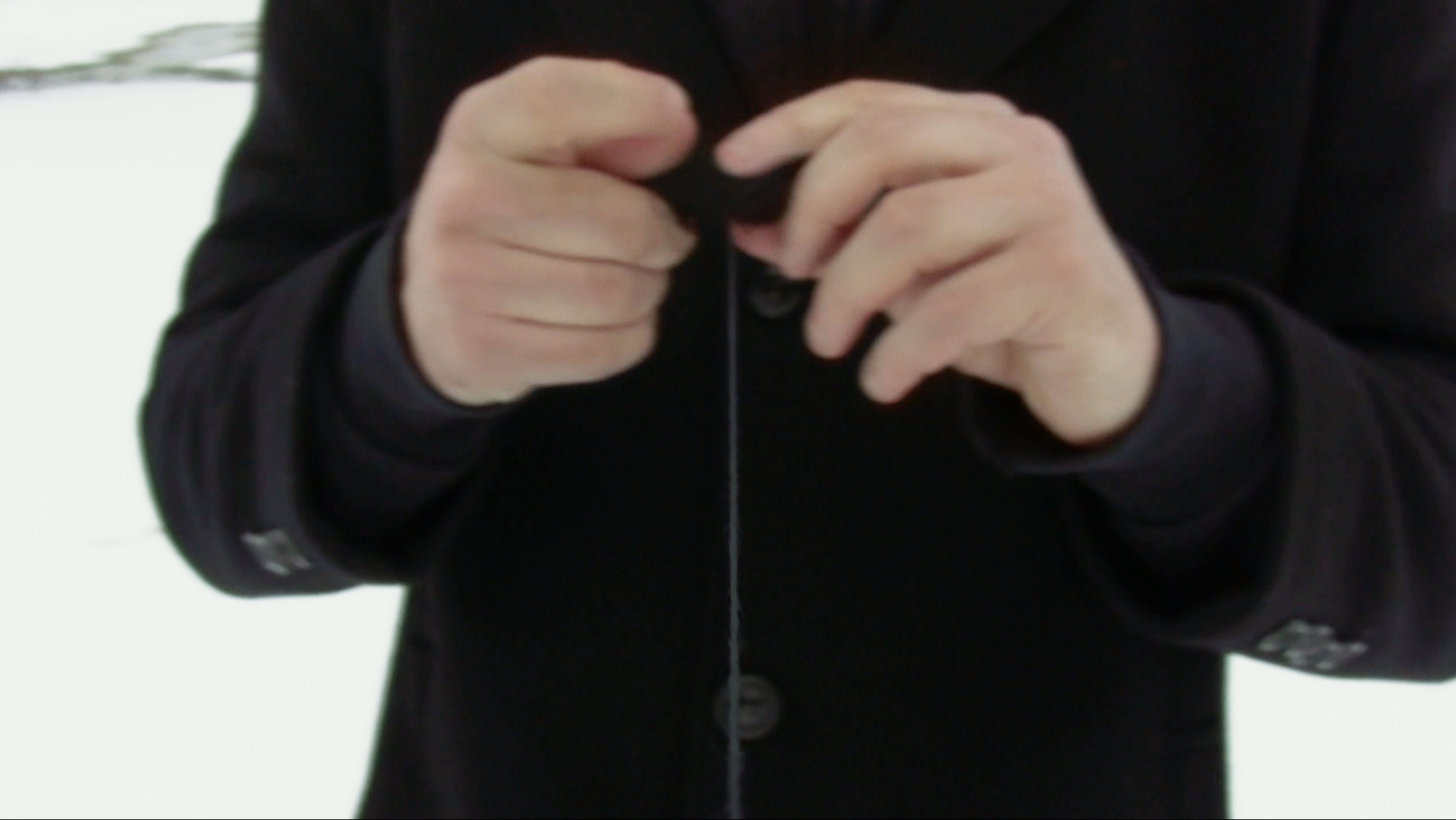
IB : Yes, exactly, as in Denouement which, for me, is a movie... Something very important to say is that, in my opinion, the films or works that I make without understanding them constitute the best works for me. And when I did Denouement, I didn’t understand anything at all. This film exemplifies an anecdote that actually happened—it's funny—a discussion where someone describes a movie of Pauline M’Barek and that way I understand the denouement; I understood the movie. I went home thinking that this was something incredible, so I looked it up on the internet and only then did I realize that I had understood everything wrong, that it had nothing to do with what I’d thought, and so I made the film. But I felt that there was something being elaborated inside me, the idea of measuring, of having a string attached to the camera and the way that string leads one to experience the emptiness that separates the camera from the person in the field. What is this emptiness that has always fascinated and will have been measured before it becomes visible? What is interesting is that this film also gives a body to the object-camera, which will become the space where we are, obviously. This experiment takes place more intuitively, but for this to happen, it is necessary to frame the elements well. It took quite some time for me to understand that it had to be snow and, gradually, to find the right film caliber. Then there is something that gradually takes on form, things that you find or recognize little by little. You end up recognizing that maybe snow is the right support... Precisely because this begins to create an enigma, the initial space is pure digital light and then turns into a landscape of snow. If it were, say, a street, it would have been a street from the beginning. But I had no idea of this, it was only by experimenting that I finally came to understand.
BS : We get the feeling of this kind of plan with the experimental device or protocol that is established, and a kind of form ends up emerging, and I don’t speak of form in the formal sense, but as a kind of attempt to take the essence of a singular gesture, something like that.
IB : Something more precise, actually.
BS : Exactly, it's always more precise. So, to what extent do you expect something common? And here something that interests me particularly is to leave this difference between the particular and the general, and to think of the singular and the common. I have the impression that you work a lot in this place, of the singular and the common, instead of the particular and general, which would lead to the universal, etc., whereas the singular and the common seem to me a more interesting pair. And in the discussion with François Piron and Guillaume Désanges, you also speak of the universal.
IB : Yes, but I think that was nonsense. In fact, it's a word I don’t understand that much.
BS : Too abstract? Too big?
IB : No, what is beautiful is that it comes back to the discussion, and yet it is a word made to be crumpled up. It’s subject to controversies. Let's say that the word universal, because I ended up re-reading the interview and found it a bit bizarre, but in the end, more than the universal... In fact, there is nothing universal about it, it is closer to something we have already seen and, in the conversation with François and Guillaume, the idea of déjà vu, of recognizing something, a certain manifestation of the unconscious. At times, certain works summon gestures or things that we have the feeling of already having seen and experienced on our own, because they’re seeking a place or something quite archaic and innate, very archaic. I have this impression. As for crumpling up and straightening out, it's something so...
BS : When I speak of form, I am using the term of a sociologist, Georg Simmel, who speaks of these forms and, clearly, does not speak of economic consequences and such, but a rather strange sociologist who is more interested in form, how things are built up and how we find these forms on several different levels: at the level of the discussion, the building of a group, or a political party—not what they’re for, but how they work. And what I see in the work is something that may not be universal, but anthropological, on the order of the human, and that is why I end up returning a lot to the question of text, of poetry, because I think words become weights and objects, gestures as well. I think you're very much into this universe of things...
IB : And why is this good?
BS : Because I have the impression that the titles play an important role, sometimes they are in friction with the work, they’re not really illustration nor a kind of synopsis, it is the smallest kind of poem you can make. You take a word and glue it on the movie, and I don’t know how your choice of titles happens. You could call them "Untitled", but you don’t do that, you give them titles. And I think the titles create something at the level of the perception of the work for those who look at them, because we are always going to put some labels on at a given moment.
IB : Often the titles emerge at the end. They usually come at the end and it ends up being very complicated, often because someone comes and says, "You need to give it a title."
BS : But you could choose "Untitled".
IB : Yes, but still, it’s not easy.
BS : I really understood it like that, as a kind of word that comes to add something to the work.
IB : There’s also the idea of compression. I think that in this exhibition here there’s an energy that interested me. An energy of compression, or of dilation. There are places where things get compressed, I think, that are so precise that they compress, while others, like Foyer, are radiant. Works that radiate, when they focus on a detail, touch things that are in their surroundings. It’s a question of circumference, that is, the detail and its surroundings may enter into a kind of interplay or friction that interests me. How to observe and be precise with a detail over the months until, at a given moment, there is a compression effect that ends up saying something about the environment. Centripetal and centrifugal forces at the same time, who knows... And the word is a work that will need a little something else.
BS : This gives it weight.
IB : Yes, it will compress. But sometimes it doesn’t work out either.
BS : How—in which work, for example?
IB : Ligne [Line] doesn’t mean anything. Someone suggested that word to me, I thought it was great. [laughs] Now, I look at this and think: a line? What does that mean? I don’t know. But I really like it because that work is so precise and so on, but there’s something in the title that goes wrong. It's funny, it went wrong.
BS : I agree with you. Of all the titles, it was the one that got me the least.
IB : Because I think it went wrong.
BS : Now I'm going to change the subject and refer to how such work circulates and can be seen in other places. As I told you, I work in a universe that, necessarily, in Brazil, is linked to current political issues, which is very much engaged and sometimes even indoctrinary. So I don’t know if it is my way of seeing—which is also fueled by a cinephile's eye—, but when watching certain films, especially Denouement, it made me think of this incredible film by the Lumière brothers in which a wall is mounted and dismounted. We find a kind of camera presence as an almost magical gesture in their films that we reconnect with the history of cinema. At the same time, I saw something very engaged in your films. I don’t know if it’s my way of seeing, but they also seem engaged with these experiences, with a context, perhaps even with rather harsh gestures. When you measure the distance in Denouement, I saw it as a rather harsh gesture, because the distance is insurmountable. There are oxymorons like this that present themselves and that emerge in the experience, sometimes in this way that leaves us surprised with the ending, even though it has very funny moments, like the face, the touch of the string—there’s a kind of acceleration of time. And when I hear your work, when I enter the room, when I hear people talk about it, there’s a lot of talk about a certain silence, about meditation, but I keep thinking about the scream, actually. What I hear most in your work is what screams out and that can be a silent scream, of course, but I see more of that type of marking. I was wondering if this reverberates with you or if it comes mostly from the context in which I’m inserted...
IB : About the scream, I don’t know, but I think it's an extremely restless work. At a given point it becomes an obligation. Perhaps because they are works that are made in a state of extreme disquiet, and this isn’t really all that important, but I perceive a great disquiet. Everyone talks about the fragility of the tremor, but that's not exactly it, there's something very uneasy about it.
BS : Very uneasy and very hard, which is in the precision. Exactly, there is something of slowness, of not being able to err, of having to point out. At the same time, something that, when pointed out, disappears. And the voices of the young Tunisians who talk to you, the cop, the guy who invites you to smoke marijuana, etc., are poignant voices. And I hear the word fist in it...
IB : Yes, in Foyer, for example, a work that clearly, like Orientation, exposes my biggest complex. And that's what impresses me, because I spent my whole life trying to hide the fact that I don’t speak Arabic very well; to hide that the place that is the most pungent for me is also the one that most escapes me; that the space and the people that I like the most are those that are farthest from me. And when I found myself making the movie, this issue really exploded. In fact, this inevitably forced me to accept something extremely disturbing for me and put me in a position that makes me uncomfortable in that situation. Anyway, what you said is completely true, that is, I think of trying to point to a place that slips away permanently. To attempt to prepare everything or find the moment when something, a central element will be located. I don’t know, the place is kind of everywhere, but there is necessarily the sensation that it will always escape, that we will never in fact arrive, that it’s kind of futile and that, nevertheless, there are many forms that destroy themselves, that decompose, that the apparition always shows itself in a permanent disappearance, this kind of thing.
BS : Yes, and that may reveal a bit of optimism, but what touched me, more than what escapes you, is what escapes on its own. More than the things that act on their own, are there things that escape?
It’s this place where you don’t feel legitimate that seems to me to be the richest, because it is from there that you truly have the observer’s position. You are both inside and outside, you’ve found the perfect place for being comfortable being illegitimate.
IB : Why comfortable?
BS : Because you found a site. A place you can occupy, where you can converse, listen, let people question, because you let them talk, let the voices of the others be recorded. There is a generosity, as in Foyer, because you give a voice to the other. At the same time, they say what you would like to say, there is this strong give-and-take. In fact, it is curious when I speak of screams and of something very political, because this echoes Brazilian production in the 1970s, from the military dictatorship period. I kept thinking this. And this is also something that is very present and that comes back in the Brazilian production of the 1990s and 2000s, that plays with forms to create situations that establish small instabilities from the inside. For example, there’s a beauty of a work by Cildo Meireles that is called Cruzeiro do Sul [Southern Cross], which is a small cube that can be presented inside a gallery that is who knows how many times the size of the cube. So when you enter, you don’t see the cube, only the empty room. But the cube is there, present, and it’s the cube that justifies the room. This interplay of micro and macro is very much present in your work and I don’t know if it is linked to the macropolitical situation, or to a personal disquiet, or perhaps—and this is often the case—to questions of subjectivity that are also linked to a situation you’re in, that you live in, you dwell in, issues of identity, of displacement... It is as if you tried to deceive or dribble the censorship. [Ismaïl laughs.] And as I was saying, we understand a bit about this censorship you're trying to dribble, that is, the best way to talk about it is to dribble it. I don’t know if it makes sense to you this kind of reflection that ends up bringing your work closer to an issue that is dear to Brazil—especially now with the coup d'état and everything else, but in your work, in this sense, in this singular gesture that is political in another way, if you don’t want to say something, there is something else that is said very forcefully. So how do you reconnect these facts, and things that touch you as well? We spoke of the revolt in Tunisia, we could talk about what happened in Paris, in France, with the Nuit Debout. These are things that affect you, because you really are in the place of affection; more than a macropolitical place, it is a micropolitical place, it’s affection that acts. For you, is this something that is present or is it more unconscious, something that traverses your work?
IB : No, it's unconscious. Really, I'm not saying that for... The question of what affects me really is important. That is, I begin to realize, now that I have a certain quantity of works adding up, that there is something for which the work becomes a kind of conductor. The fact of working means to conduct, to accompany the energies, to make certain things visible, or to let them manifest themselves on their own without even realizing it, and this happens in the way you described, which I think was very well expressed. It's something that touches me. I'm not talking about my work anymore, but about what you said. If that were the case, it would be wonderful, but I don’t know. That's why I said just now that I'm never so—how can I say it?—so attached to attachment. I never give so much thought to a work I’ve made as I when I have the impression that I didn’t understand it.
BS : When it escapes you.
IB : When it escapes me, when I have the impression of having to pass by to recognize something, perhaps. This is why the question of recognition is very important: you recognize something unconsciously, you let yourself be permeated by it unconsciously and in a very disquieted way, and that is why the disquiet is present; these are extremely unpleasant moments. Until, at a given moment, when you liberate yourself from it all because you move on to something else, you begin to grasp, to see that something has happened. Sometimes.
BS : That is also why the reference to Robert Bresson seems to me quite beautiful and subtle when I think of "A man escaped." Your films are a bit like escaping death row.
IB : I don’t know. But, for example, various artists often tell me, "Oh, when I finish a work, I never look at it again." This is something I’ve never understood because it’s afterwards that I see the work. And when I say afterwards, I'm talking about three, four years, ten years later. Because the work keeps on working afterwards. There is no such thing as a finished piece; that has nothing to do with it; it’s a problem.
BS : It’s a being in the world; it accompanies you.
IB : It accompanies me afterwards. Here, for example, I talked with some Brazilians about certain works and this wakened me to other things. Today I'm talking to you, which makes me sensitive to yet other things, anyway... Besides, something else that's important to me is that, for example, following up and taking care of something that has been done is also a way of reactivating other things further on; that’s how it works. There is no such thing as ending one thing and moving on to the next, I never could understand that.
BS : Now a question... Moving on to the part that’s an interview... Is there anything here that you’d like to know, something that intrigues you, interests you, something you would like to say? Things that you’ve seen here and would like to talk about?
IB : Well, something that hits me hard... To contextualize, as I told you, I came for the exhibition, so I don’t have the feeling that I’ve actually seen the city, I'm just in a city. I agreed to come now and then come back in a month to have time to see. But what strikes me is the extremely violent friction between worlds, bodies, economies, ways of living. It's something I've observed in Colombia and that's what I could see here. It's something that jumps right out at me all the time. It is pungent, but what I have seen is just evidence, I don’t know. I still don’t understand anything about the city.
BS : Don’t worry. It's a city where there’s a lot that we don’t understand. But we become attached to it.
IB : For example, how should I say... I didn’t find much of the aspect... This is requires tact. But in Tunisia, for example, there are great social disparities and differences, but the separation is less blatant. It’s starting to intensify a bit more, unfortunately. I don’t know, but here, for example, we are in a building, an art center, I don’t know what they call this, but we live in another world. I cannot help but wonder, how much does it cost to mount an exhibition? All these projectors, all these lights...
BS : You’d have to ask Rodrigo that.
IB : The number isn’t important, it's the contrast, actually. But inevitably, when you leave the exhibition, there's this thing that jumps out at me, that's not normal. It's even more hard-hitting here, I think, than in other places where I've exhibited.
BS : But as we mentioned about before, Tunisia’s identity was reconstructed after its independence around a desire for homogeneity.
IB : Yes.
BS : And this is still present, in a way. Here, on the contrary, it’s true that it’s almost a society of castes, with such a strong and marked social difference. But I think this is the curious and interesting aspect of seeing your work here. I have the impression that, just as what is not shown leads me to see something else, in what is not said we can hear this tension, these cries.
IB : I don’t understand. You're not the only one to say this to me, but I still don’t understand.
BS : In your work?
IB : You’re not the first to say that it is peculiar to see my work here in this context... I still don’t get it.
BS : It's as if we were, at the moment, in a situation... I would say that what makes life as such has almost lost its value. There are massacres that happen regularly and life goes on, but without life. And in your work, the first work, Ligne, with the drop of water, is as if it could point to the importance of breathing, of a heart’s beating, of being present, of fragility, but with that precision of which we spoke just now. Then it seems to me that many other works also reveal this kind of care.
IB : Yes, that's it.
BS : You take care. In the presence of the other, you pay attention, and for us this contrasts forcefully with the moment we’re in; we are much more marked by the contrary, by difference. It’s time to land, as they say here, to come back to earth. Maybe that would bring us closer to the other, but in a very different way from what a Brazilian would do today, in my view. In terms of local production, maybe it would be a work that could be present in a time of censorship.
IB : Really?
BS : What I said about pointing to something that can’t be named—that’s something we can feel in your work. Another aspect that is interesting... Apart from the question of the care you take, which is a first aspect that valorizes the vital drive, the presence of the body. And even a faceless body is a living, breathing, pulsating body. I would say that you humanize even the objects—perhaps you dehumanize humans and humanize the objects. In the end, we come out ahead. The second thing I would point out revolves around what cannot be said, the unspoken, the absent. And we are in a political situation so tense that we end up reestablishing a connection with the era of the dictatorship, the censorship, the silence. So, perhaps we recognize a more distant Brazilian production; I spoke of Cildo Meireles, but it is possible to return to other very different works, like that of Letícia Ramos, who writes the name of the country on her own foot with a thread... We ended up finding gestures that try to create a pain that cannot be spoken. Maybe this doesn’t hit close to home at this moment because it wouldn’t be done this way, but when we see it, it finds an echo in local production that also makes sense. I think that would be a second point, first the question of taking care and then the question of silence. I don’t know if I'm coming to a close too quickly.
IB : No, no, that interests me a lot. Because it is true that when I was invited to do the exhibition, this was part of the discussion.
BS : What?
IB : They didn’t say it this way, but they said it was important to them. I didn’t understand why, I even thought it was a question of courtesy. I don’t know, that might even be the case. They said it was important today and I couldn’t understand, I just thought “okay”. But maybe you're putting into words something that reappeared several times without my understanding it.
BS : Now we can go for a walk around town a bit.
IB : We can do it now.
BS : I want to show you some places.
[A discussion follows about family, food and various interspersed conversations.]
