Om acht uur? Dan word ik wakker.
As part of
The Last Terminal, Volume III Part 6: Colonotopia
Artists : gerlach en koop exhibit works by Steve Van den Bosch, Annaïk Lou Pitteloud, Shimabuku, Ismaïl Bahri, Gabriel Kuri, Hendl H Mirra, Mark Geffriaud, Ian Kiaer and Jacqueline Mesmaeker
27.03.2025—27.07.2025
Rib
Katendrechtse Lagedijk 490B
3082 GJ Rotterdam
The Netherlands
Exhibition handout is available here
Website gerlach en koop
Art viewer
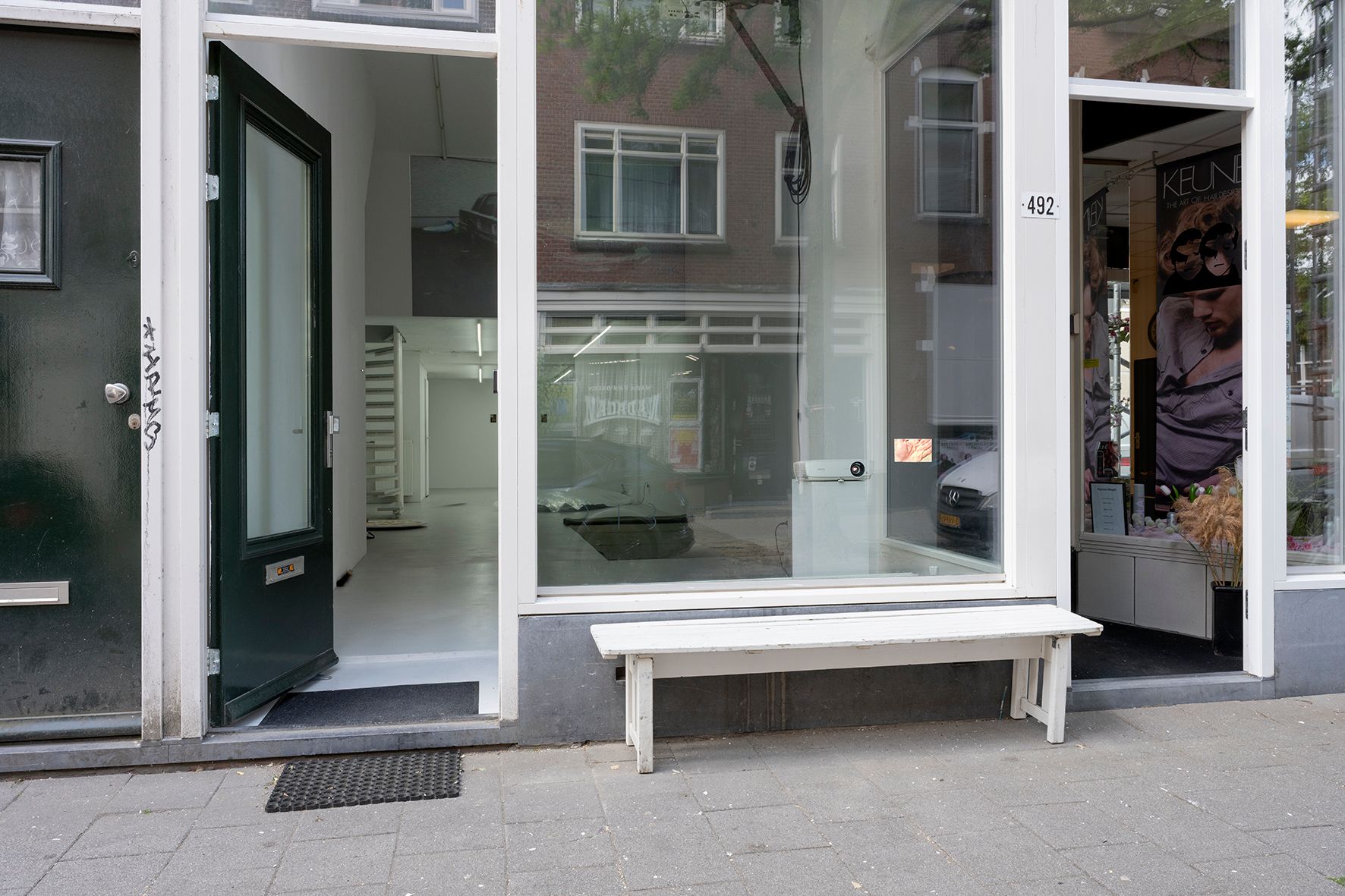
For the exhibition Binnen en buiten het kader at the Stedelijk Museum Amsterdam in 1970, Gerrit Dekker closed a gallery by closing two doors. There is a photograph documenting the empty room from the inside, taken at a very low vantage point. This is what you would have seen if you were lying on the floor and looked to the side. For Dekker, spending time in exhibition spaces was important. In a sense, his installations—though that term was not yet in use then—are the result of performances without an audience.
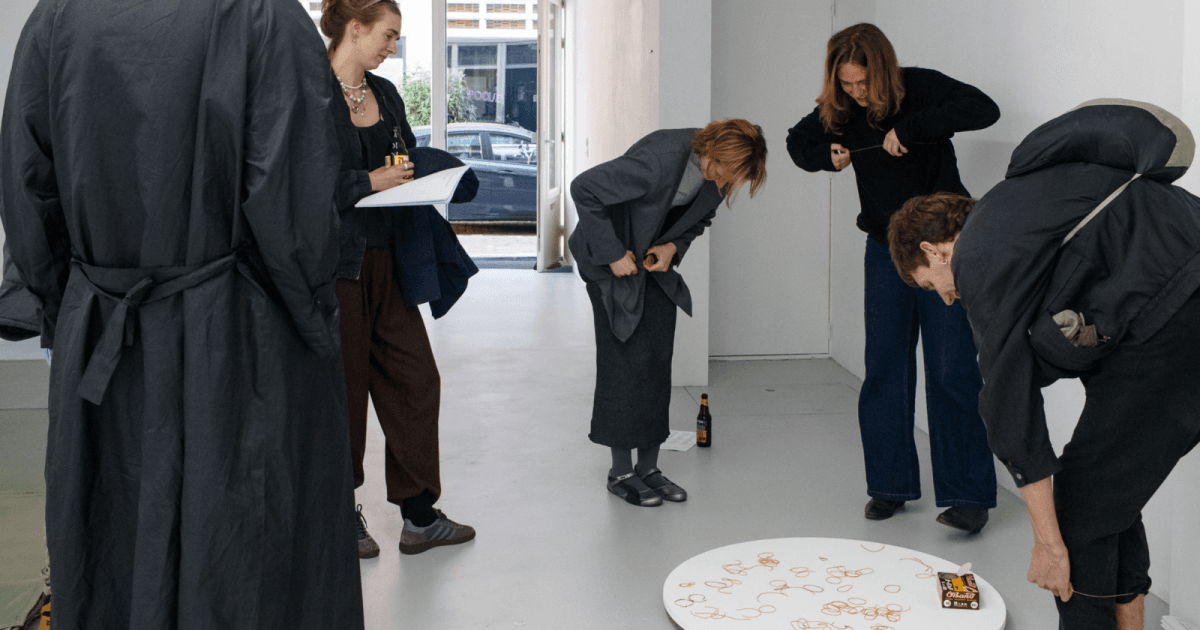
Dawn breaks the surface. The eight hours of Om zeven uur? Slapen. have separated everything in before and after. And now gerlach en koop continue and end their restaging of Was machen Sie um zwei? Ich schlafe. from 2020. For this last gathering gerlach en koop will display all works that correspond to the reintegration and melancholy of waking up. A true gathering therefore. The exhibition will be open and can be visited from 27th March but the opening will be a month later Friday night 25th April.
ISMAÏL BAHRI
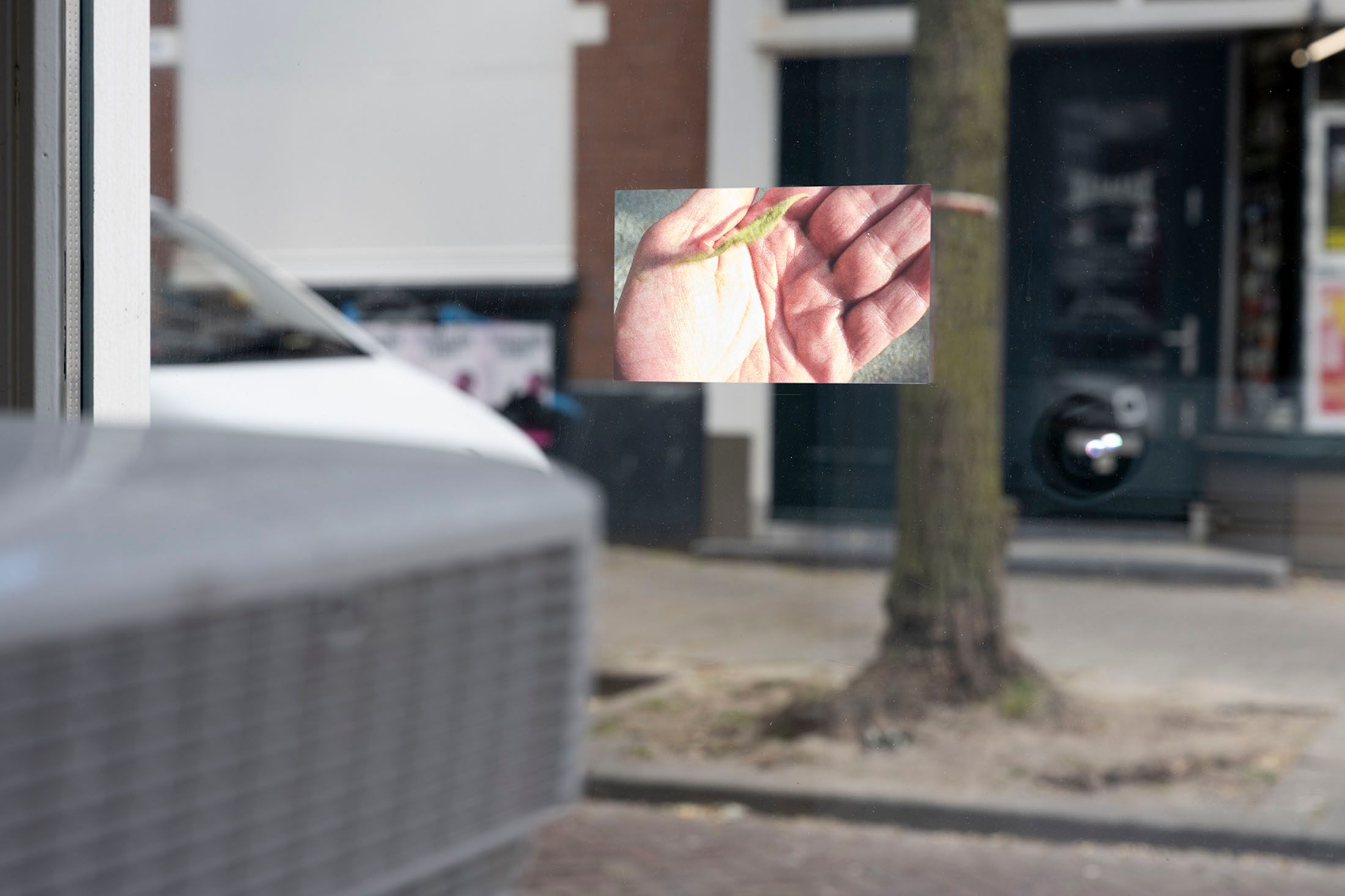
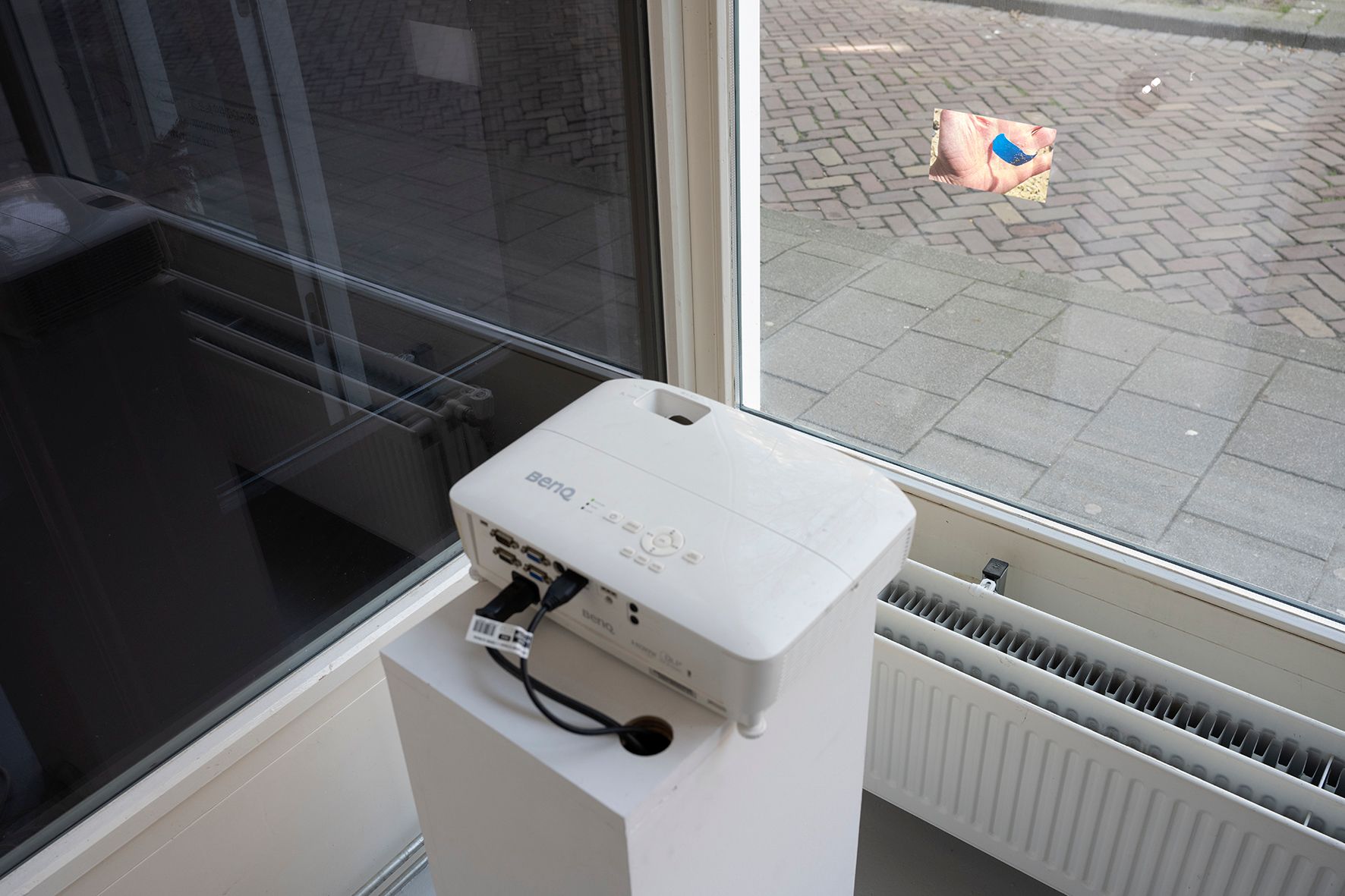
Somebody showing you something. What these things are – not things but fragments of things – you can’t really discern. The wind makes it difficult to see more than a fragment when the hand opens. You see a fragment of a fragment. You are tempted to consider it as one, single thing. Maybe it is. A single thing that changes shape, colour, texture while you’re looking at it. It changes because you’re looking at it.
An earlier version of the video is titled Lâchers [Releases]. A hand releasing again and again. Leaving it to the wind. But it’s an ongoing project; whenever the wind is good, Bahri returns to add new material. This version is titled Saisir, a French verb that means ‘to grab’, also in the sense of ‘to grasp’, ‘to understand’. The best English translation would be: Seize. And yet that would be just the opposite: a hand that tries to hold on to something. Keeping it from the wind, so that it doesn’t blow away.
Looking at it means that you’re trying to hold on, too – to remember what you just saw.
‘Repetition’,* says François Piron, ‘is an instrument of insistence’. ‘Repetition is a way of getting everything out of yourself and out of things in order to retain the tiny amount that resists’, Ismaïl Bahri answers. ‘I try to get to the point where it holds together, but in the hope that, from that point, having persisted, something continues to escape, a vulnerability that is expressed through tremors or vibrations.’
After many attempts, you finally wake up.
*This and subsequent quotes appear in: ‘Leaving It to the Wind’, a conversation between Ismaïl Bahri, Guillaume Désanges, and François Piron, in: Instruments, Jeu de Paume, Paris, 2017, p.158.
ANNAÏK LOU PITTELOUD
An Executive Series Ford Lincoln Town Car was found in the port of Antwerp. Koffie Natie, a coffee import-export company, found it submerged in its basin during a shipping manoeuvre, extracted and stored in its car park where it remained for many years. The car was probably new when it was sunk in the harbour, as evi- denced by its perfectly preserved blue leather interior, while its bodywork bears the traces of its immersion.
The car was exhibited under the title They on the grounds of the Rijksakademie van beeldende kunsten in Amsterdam during the open days of 2010. As it was impossible to sell or store this piece, the car was sold to a shady figure after the exhibition and may now be driving through the streets of Amsterdam.
The short film Perfect Europe (They) was shot when the car was discovered, on the evening before it was removed from the port of Antwerp. Thus one piece bears witness to another, of which nothing remains.
MARK GEFFRIAUD
Every time you pass through a doorway, your thoughts are somehow reset. Most of what you had in mind is erased to make room, to adapt to the new space that you are entering. Though we usually don’t even notice, it does happen that a person enters a room and then suddenly finds themselves unable to remember what they wanted to do there, or what they went there looking for. Scientists call it the ‘doorway effect’. It is a feeling akin to waking up.
A door spindle – being the only element connecting both sides of a door – measures the distance between these two states of mind, making room for a whole new way of looking at this very simple piece of metal.
Measure it and several striking coincidences emerge. The distance range between the holes made to allow knobs to fit doors of different thicknesses are exactly the same as the distance range between the two eye pupils of a human adult, which is to say between 5.5 and 7cm. The holes themselves measure 0.2cm, which is the maximum contraction of a pupil, and the piece of metal itself has a thickness of 0.8cm, which is the maximum dilation of a pupil.
In fact, this object marks a whole set of coincidences. It is a hyphen – a hyphen between different spaces, different territories, different states of being.
And remember, kings don’t touch doors.
HENDL H MIRRA
Pathetic coverlet for concrete. Made of rectangles of typical American sidewalk size, connected with a slightly darker, fuzzy-mossy stripe. The sculpture can be installed at full length, or with some part of the length accordion-folded at one end only. The fabric was dyed green in sections at a laundromat on the corner of Division and Paulina in Chicago, where Mirra lived at the time. The rectangles were thus in slightly different shades of the same hue, and have since become further varied by inconstant sun-bleaching.
SHIMABUKU
Trying to Wake Up
The night leaves me cadaverous.
The corpse has to be revived. However, I don’t have the impression of being a dead body in the morning.
If someone could see me at that time in accordance with my impressions, I would appear as a sea of clouds, a globulous sea of masses of flakes, a huge object that no doubt borders on the stratosphere.
Cloud though I may be, I am well aware that this state has its enemies, that I will soon have to become active again, de nite, reduced in size … and that it would be wise to start moving in that direction (if it isn’t too late for me to wake up, ever). I get busy immediately.
[…]
Courage! In this mass a will remains.
This headstrongness without a body is vaguely growing.
[…]
Soon I’ll be able to get up. I am now just a few minutes away, and with no obstacles on the road to the near future, I am now a man like minutes away, and with no obstacles on the road to the near future, I am now a man like any other.
It happens, but much more rarely, that I awake (from this half-sleep I’ve been talking about) on four legs. In that case I need more time to return to biped shape, because – I think – of a certain propensity I have for living in that state, which I don’t have for my cloud shape. I’d certainly be prevented from doing so even if I wanted to, and I would be too afraid to stay that way. Although, after all… I’ve come out of it many times in the course of my life. But all it takes is once, when you forget how to deal with it and you stay that way forever, until you die.
[…]
—Henri Michaux, ‘Trying to Wake Up’ [Arriver à se réveiller, 1950], translated from French by David Ball, in:
Darkness Moves, Berkeley: University of California Press, 1997, pp.95–100.
IAN KIAER
Cylindrical House Studio, 1929
The distinctive shape of Konstantin Melnikov’s two conjoined cylinders and strange hexagonal windows speak of a structure beyond everyday dwelling. lts geometry, white surface, and remote, singular poise appear designed to provoke rumour of more complex workings within, as if the circular solution and eclipsing diameters might conform to some mystical planetary alignment or map an over- lapping design of halos for an icon of orthodox saints. There can be few buildings with this many windows, over sixty in all, that remain so insistently insular. lt may even be the quantity that works to deny any notion of view and emphasises their alternative function as luminaries. They absorb light from outside but hardly provide an inward glimpse in return. There can be no looking in.
lt is somehow appropriate that their origin can be traced to a fortification sur- rounding Moscow’s ancient Belgorod district, as they a ect to alienate and repel the world.
It’s not only the windows’ honey-comb shape that might prompt the idea of bees, but the way in which its smooth exterior wall, if sliced open, would reveal a complex of interlocking work and living spaces where the incubation of thought and sleep meet. The architect wanted to integrate sleeping and working, dwelling, and thinking throughout his building; hence living-room, studio, and bedroom alternate and dissect like a layered Venn diagram. It is said of the cylindrical motif that he had the Russian hearth in mind* – the hearth as core of the house with the notion of warmth enclosed, its most interior part. To conceive this notion of hearth/heart is to turn the whole building inwards. To think of Melnikov’s building is to think from its inside.
In the house, work and sleep are curiously connected. The circular bedroom is directly below the circular studio. The walls are painted warm yellow; the beds are stone slabs that rise up from the floor like altars, rendering sleep an almost sacred inactivity. For Melnikov, sleep was an area of intense study.** He wrote about a lifetime of sleep, twenty years of lying down without consciousness, without guidance as one journeys into the sphere of mysterious worlds to touch unexplored depths of
the sources of curative sacraments, and perhaps of miracles.***
Here sleep becomes a means of passing from one world to another, mysterious and indeterminate, a place for work’s reserve to be restored and nourished. However, such spaces have a way of shifting tone, from sleep’s place to death’s space. From the thirties on, sleep’s curative sacraments turned to restless slumber as Stalin’s censure became the architect’s incubus, frustrating any possibility for practice. ln such light the warm glow darkens into night, and those concrete beds come ever closer to mortuary slabs. Without recourse to sleep Melnikov turned to dreaming, closing inwards to past projects and painting pictures.
The beginning of those concrete beds perhaps lay in the commission the architect received to design Lenin’s glass sarcophagus. ln this, his first built structure, he had to provide a plinth of sleep for a cadaver forever
preserved, a place of pilgrimage and peering – a windowed tomb. There is something determinedly circular in how this first work, which signals his professional birth, presents itself as a death work. As if somehow opportunity demanded he earn through experience what he had conceived through commission. He could not know that his cylindrical house studio – designed with such optimism as an ideal space for living and work – would eventually become a place for sleep, a house for a corpse.
—lan Kiaer, ‘Cylindrical House Studio, 1929’, in: Picpus, issue 4, Autumn 2010.
*A.A. Strigalev, ‘The Cylindrical House-Studio of 1922’, in: Konstantin Melnikov and the Construction of Moscow, eds. Mario Foss and Maurizio Meriggi, Milan: Skira editore, 2000, p.90.
**ln 1929, Melnikov designed a ‘Laboratory of Sleep’ for workers in the ‘Green City’, see: S. Frederick Starr, Melnikov: Solo Architect in a Mass Society, Princeton, NJ: Princeton University Press, 1978, p.179.
***Ibid., p. 177.
GABRIEL KURI
From the dimensionless void that is sleep ‘we are thrown into the body, into the world, into time’,*
Peter Schwenger writes in his book on the threshold between sleep and wakefulness, and this inevitable and disastrous setback repeats itself every morning. ‘It is our fated placement in the world – fated because we do not choose this place, which is not like any other because it is us.’
We’re washed ashore. We leave behind wrinkled sheets resembling a coastal landscape of frozen waves as our feet hit the floor and we open the bedroom door. No longer asleep, but awake? Not quite yet. It takes us a while and sometimes a while longer to shake off that subtle smell, that hint of melancholy coming from within.
Mourning for a loss will pass, or can pass. We can expect the intensity of the feeling to fade at some point, but this melancholy of waking stays with us, forever on repeat, every morning anew. And precisely because we do not know what we’re grieving for, or even identifying it as a loss, we cannot learn to understand and accept it.
*All quotes from Peter Schwenger, At the Borders of Sleep, on Liminal Literature, University of Minnesota Press, 2012